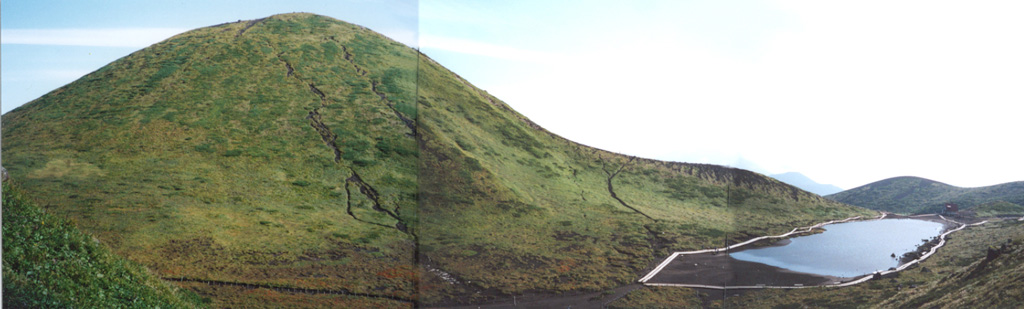
Two calderas partially filled by basaltic cones cut the summit of Akita-Komagatake volcano. The larger southern caldera is 1.5 x 3 km wide and has a shallow sloping floor that is drained through a narrow gap cutting the SW caldera rim. On its northern side is a smaller more circular 1.2-km-wide caldera whose rim is breached widely to the NE. The two calderas were formed following explosive eruptions at the end of the Pleistocene, between about 13,500 and 11,600 years ago. Two cones, Medake and Kodake, occupy the NE corner of the southern caldera, whose long axis trends NE-SW. The Onamedake cone within the northern caldera has produced lava flows to the north and east; it has a 100-m-wide summit crater. Small-scale historical eruptions have occurred from cones and fissure vents inside the southern caldera. The temperatures of geothermal areas increased beginning in 2005, and some fumarolic plumes were observed in 2011-12.
Akita-Komagatake Volcano — Japan
Advertisement
Recent earthquakes nearby
- …
Biggest historic earthquakes in the area
- …
Advertisement