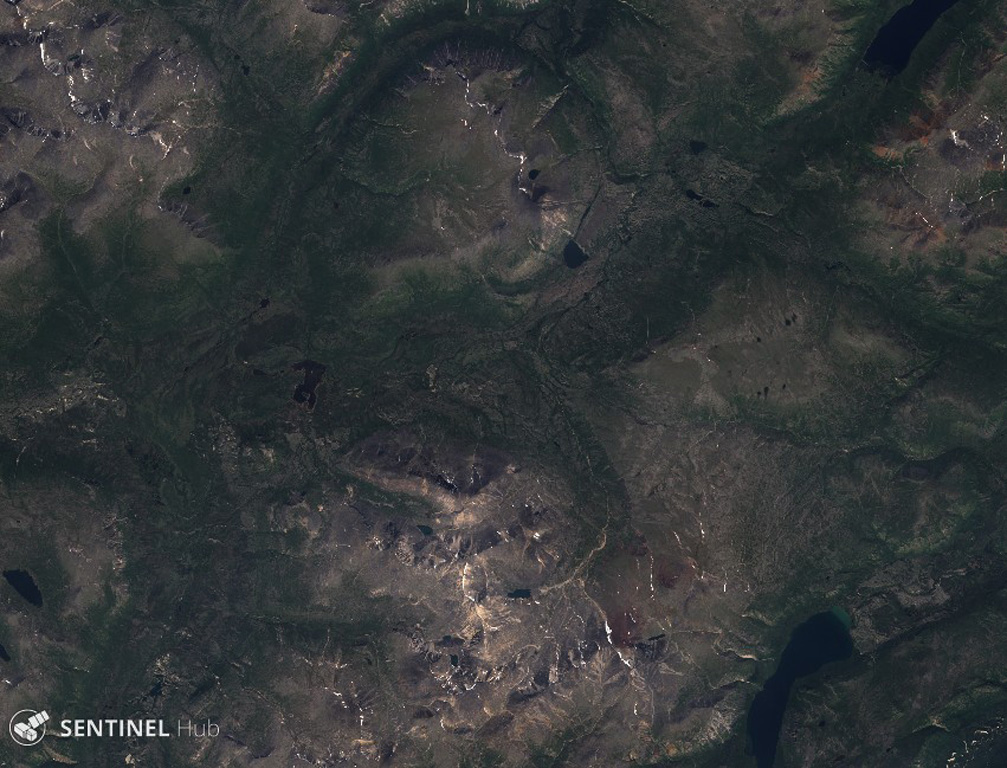
A group of basaltic cones and lava flows (the Miles Canyon basalts) in south-central Yukon near the capital city of Whitehorse was considered to be of Pleistocene age (Wheeler, 1961). The upper part of the Alligator Lake volcanic complex, consisting of two well-preserved cinder cones capping a small shield volcano, probably post-dates local Holocene glaciation (Eiche et al., 1987). Lava flows from both cones traveled to the N and were erupted simultaneously. Their compositions range from alkali olivine basalt to basanitic. Flows from the NE cone are the largest, extending 6 km from the cone and expanding to a width of 10 km at the terminus. Portions of the flows contain spinel lherzolite and granitoid xenoliths and megacrysts of olivine, pyroxene, and spinel.
Alligator Lake Volcano — Canada
Advertisement
Recent earthquakes nearby
- …
Biggest historic earthquakes in the area
- …
Advertisement