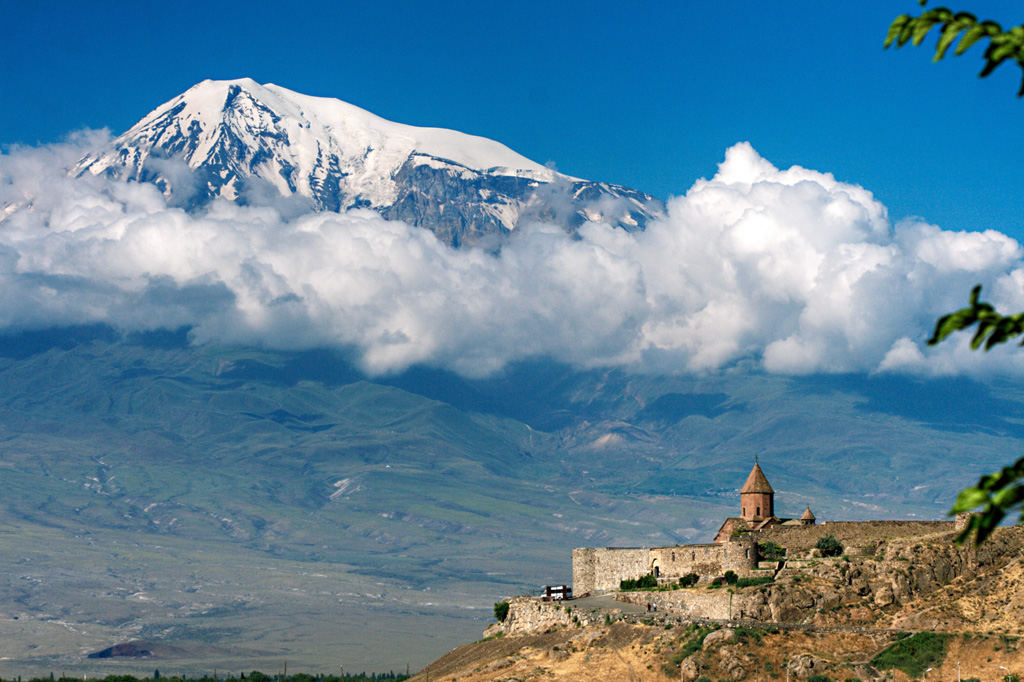
Mount Ararat, also known as Agri Dagi, is Turkey's highest and largest volume volcano. The overall massif extends ~25 km NW-SE, and 18 km NE-SW, with another large volcano, Kucuk Ararat (or Lesser Ararat), ~11 km SE. Construction of the Greater and Lesser Ararat volcanoes was followed by a period of extensive flank eruptions, many erupted along N-S fissures. The initial stage of flank eruptions produced a cluster of cinder cones and dacitic-rhyolitic lava domes surrounding Greater Ararat and a series of pyroclastic cones and domes on the W flank of Lesser Ararat. There are also large pyroclastic cones lower on the flanks of the two volcanoes. A small cone ~8 km SW of Lesser Ararat appears to be the source of a dark lava-flow field covering ~80 km2 towards the S. Ararat appears to have been active during the 3rd millennium BCE; pyroclastic-flow deposits overlie early Bronze Age artifacts and human remains. Karakhanian et al. (2002) reported historical evidence for a phreatic eruption and pyroclastic flow at the time of a July 1840 earthquake and landslide.
Ararat Volcano — Turkiye
Advertisement
Recent earthquakes nearby
- …
Biggest historic earthquakes in the area
- …
Advertisement