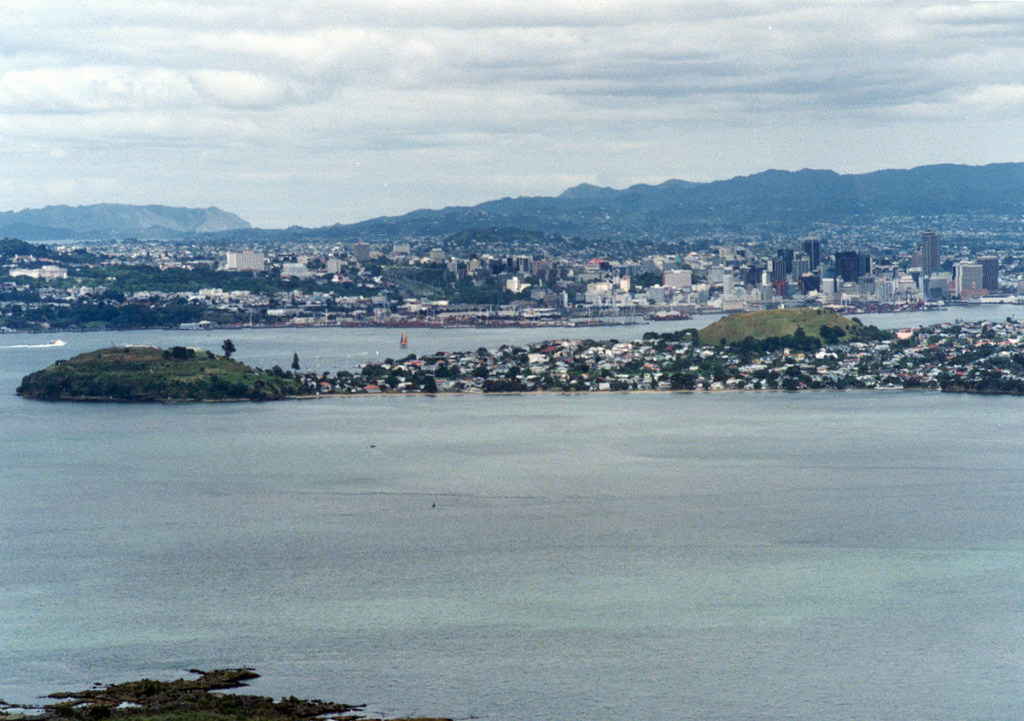
The 600 km2 Auckland Volcanic Field, at the south end of the Northland Peninsula, is overlain by New Zealand's largest city, Auckland / Tamaki Makaurau. This northernmost Quaternary volcanic field of the Auckland Intraplate Province is dominated by intraplate alkali basaltic to basanitic rocks. Fifty-three volcanic centers, comprised of maars, tuff rings, small lava shields, and scoria cones, are within an elliptical zone ~30 km long (N-S) and ~20 km wide (E-W) (Hopkins et al., 2017; Hopkins and Smid, et al., 2020). The first eruptions in the field began about 193,000 years ago, but over half of the volcanoes formed in the past 60,000 years, and there are 19 known eruptions within the last 20,000 years; only Rangitoto has been active during the Holocene (Needham et al., 2011; Hopkins et al., 2017). An eruption between 1400 and 1450 CE built the 6-km-wide Rangitoto Island, the largest volcano in the field, consisting of multiple scoria cones that cap a low shield with a broad apron of lava flows.
Auckland Volcanic Field Volcano — New Zealand
Advertisement
Recent earthquakes nearby
- …
Biggest historic earthquakes in the area
- …
Advertisement