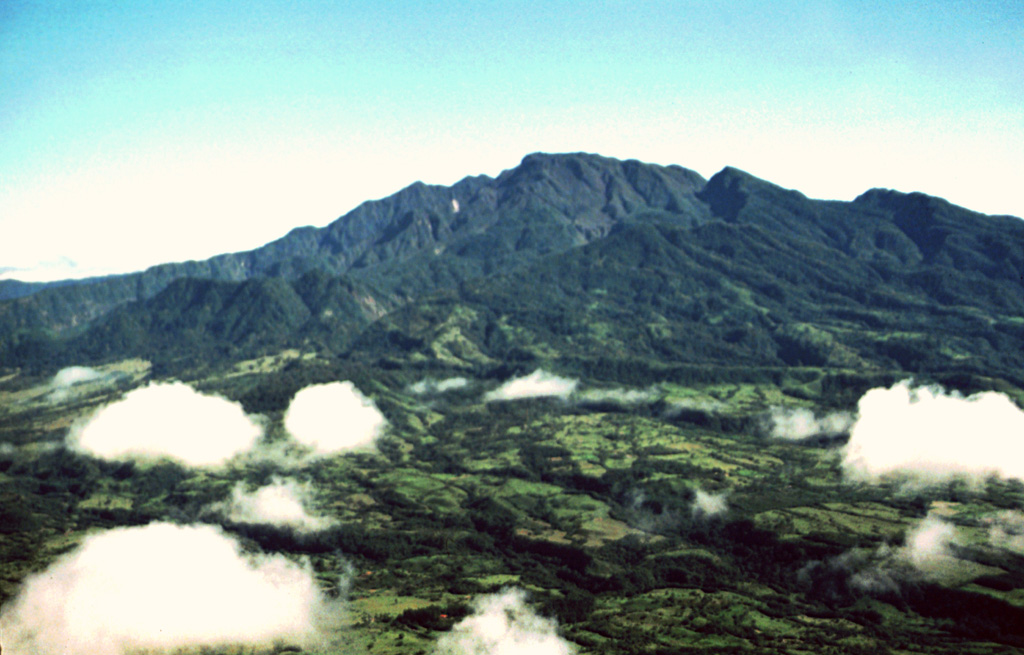
The westernmost volcano in Panamá, Barú, is a complex dominantly andesitic stratovolcano in the Talamanca Range near the Costa Rica border. The forested volcano (also referred to as Volcán de Chiriqui) is the highest peak in Panamá, and the summit hosts many communication towers. A large 6-km-wide summit caldera breached to the west was formed by a large volcanic landslide, which created a massive debris-avalanche deposit about 9,000 years ago that extends onto the Pacific coastal plain, largely overlying a late-Pleistocene avalanche deposit. Post-collapse eruptions have constructed lava domes inside the caldera that have grown to a height exceeding that of the caldera rim. A strong explosive eruption at about 700 CE ended human occupation at the Cerro Punta archaeological site NW of the volcano. Montessus de Ballore (1884) reported a strong eruption in the mid-16th century; Sapper (1917) considered this report to be uncertain, but radiocarbon dates subsequently implied tephra deposits younger than about 500 years. Volcán Barú is the youngest major volcano in Panamá, and geothermal exploration projects have been undertaken to determine its energy potential.
Baru Volcano — Panama
StratovolcanoType
1550Last eruption
3474 mElevation
PanamaCountry
Advertisement
Recent earthquakes nearby
- …
Biggest historic earthquakes in the area
- …
Advertisement