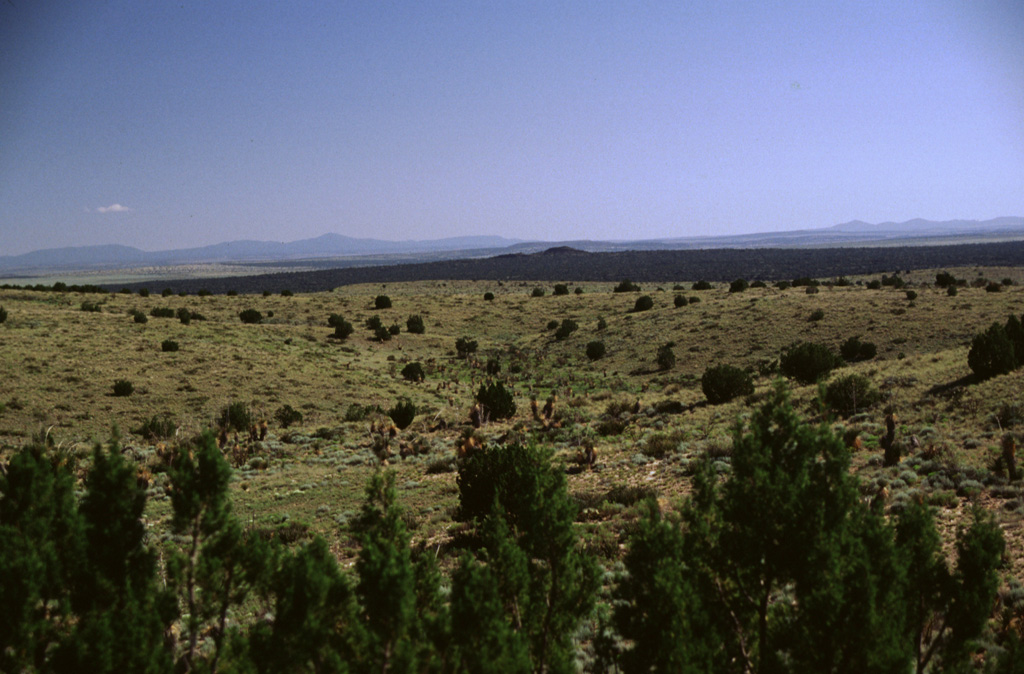
The massive Carrizozo lava flow, which traveled 75 km down the Tularosa Basin of south-central New Mexico, is one of Earth's longest known Holocene lava flows. The youthful-looking flow originated from a broad low basaltic shield on the floor of the Tularosa Basin, east of the Rio Grande Rift, topped by Little Black Peak, a small cinder cone. The 4.2 km3 tube-fed pahoehoe flow covered 330 km2 and has a width that ranges from 1 km in the central neck region to 5 km in the proximal and distal portions. The flow was inferred to have been emplaced during a single long-duration eruption estimated to have lasted 2-3 decades. A surface exposure age of about 5,200 BP was obtained for the Carrizozo flow. An older lava flow traveled 16 km S and 11 km E from Broken Back crater.
Carrizozo Volcano — United States
Advertisement
Recent earthquakes nearby
- …
Biggest historic earthquakes in the area
- …
Advertisement