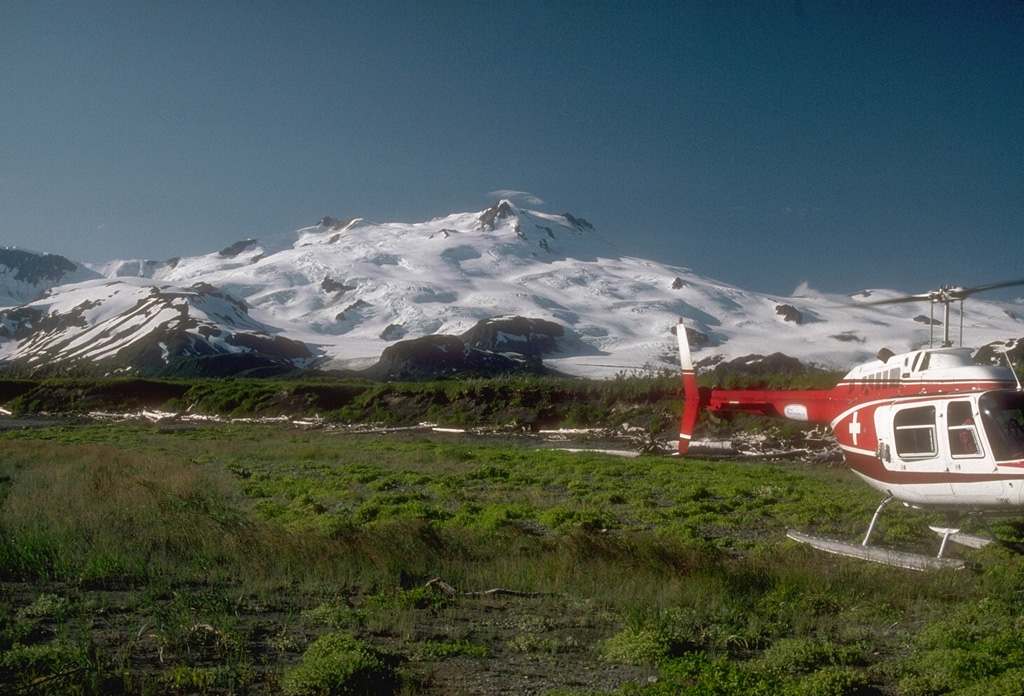
Glacier-covered, dissected Mount Douglas stratovolcano is located at the N end of the Alaska Peninsula south of Kamishak Bay, and is the NE-most in Katmai National Park. It was constructed above Cretaceous and Jurassic sedimentary rocks, and contains a small, ice-free summit crater lake and an active fumarole field. A lake temperature of 25°C and a pH of 1 were measured in 1982. Fumaroles are located on the NE wall of the 160 x 200 m wide crater lake; some are subaqueous and produce turbulence on the surface of the blue-green lake. The fumaroles, which are actively depositing sulfur, were all at the pressure boiling point in 1982 and heated up to 114-118°C in 1991. Unglaciated and relatively uneroded lava flows are found on the NW flank. The age of the most recent eruptions is not known, but Nye et al. (1998) considered activity to have occurred during the Holocene.
Douglas Volcano — United States
Advertisement
Recent earthquakes nearby
- …
Biggest historic earthquakes in the area
- …
Advertisement