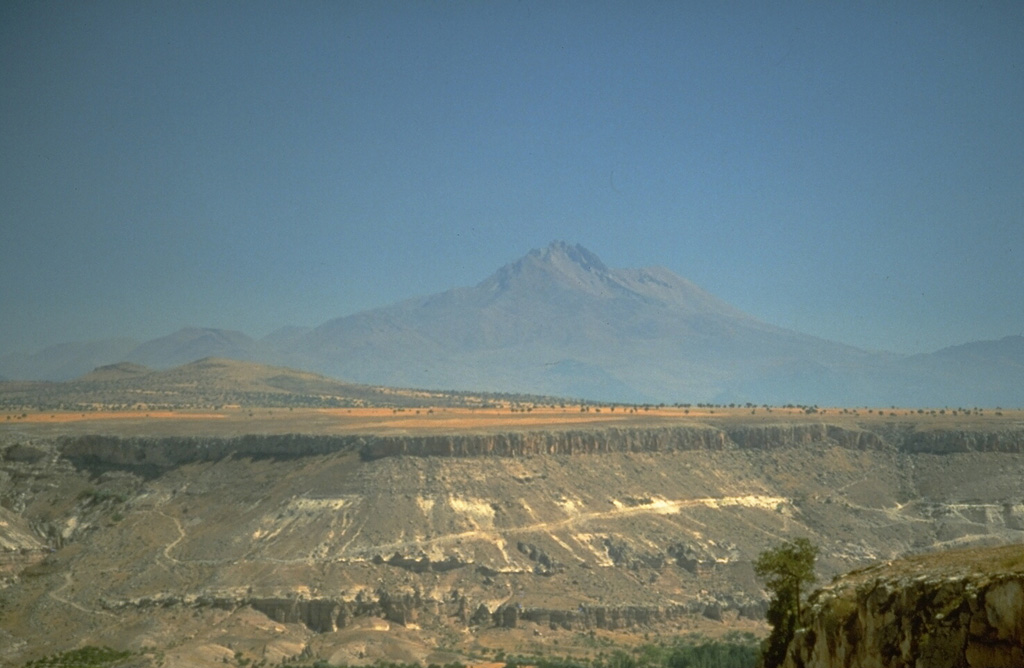
The Erciyes Volcanic Complex at the northern end of the Sultansazligi Basin in central Anatolia is dominated by the massive eroded Erciyes Dagi stratovolcano at the approximate center of a radial monogenetic volcanic field 32 km in diameter, extending further towards the N. Uslular et al. (2021) identified 100 lava domes (dacitic to rhyolitic), 40 scoria cones (basaltic to andesitic), four maars (basaltic andesitic), and 44 undifferentiated features as part of this complex. Growth of the modern edifice began about 900,000 years ago, following Pliocene caldera collapse of the Kocdag complex. The youngest dated rock was from an 83,000-year-old dacitic lava flow, but rhyodacitic eruptions and lava dome growth occurred later at the Perikartin dome. One of the latest documented events was an edifice collapse that produced a large debris avalanche that extended to the east. An early Holocene distal tephra layer in Lebanon was attributed to Erciyes Dagi. Uncertainty remains regarding reported eruptions and their possible depiction on Roman Cappadocian coins. Accounts possibly referring to eruptions could also be attributed to methane releases from a swamp in the Sultansazligi Basin.
Erciyes Volcanic Complex Volcano — Turkiye
Advertisement
Recent earthquakes nearby
- …
Biggest historic earthquakes in the area
- …
Advertisement