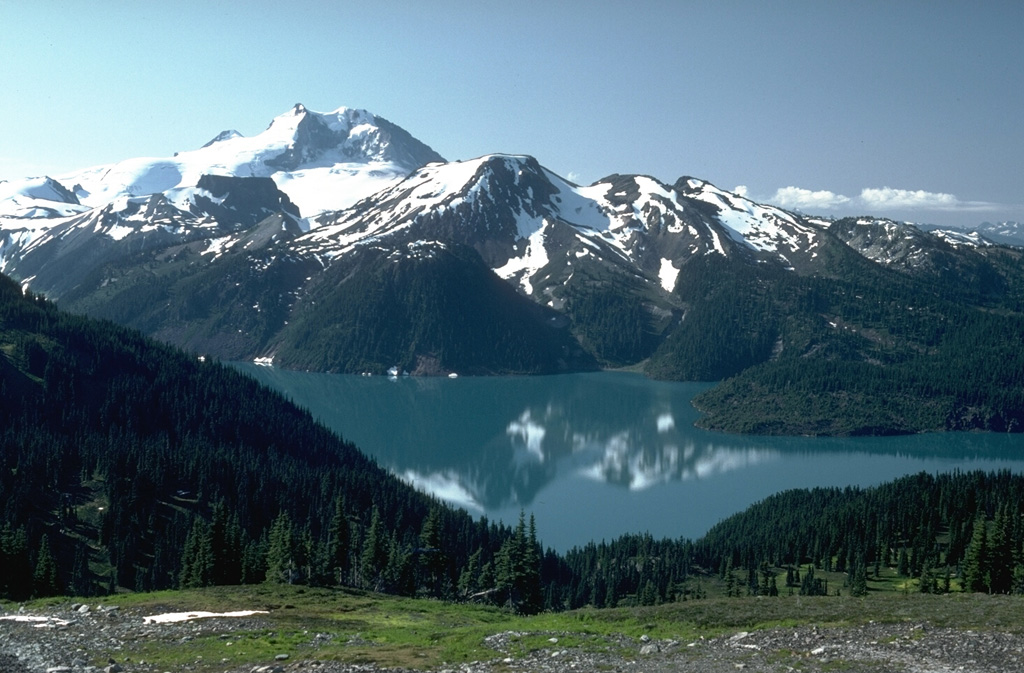
A group of nine small andesitic stratovolcanoes and basaltic andesite vents in the scenic Garibaldi Lake area immediately north of Mount Garibaldi was formed during the late Pleistocene and early Holocene. The oldest stratovolcano, The Black Tusk, formed between about 1.3 and 1.1 million years ago (Ma). Following glacial dissection, renewed volcanism (0.21-0.17 Ma) produced the lava dome and flow forming its summit. Other Pleistocene vents are located along and to the west of the Cheakamus River. The Cinder Cone, to the east of The Black Tusk, produced a 9-km-long lava flow during the late Pleistocene or early Holocene (0.04 +/- 0.04 Ma). Mount Price, west of Garibaldi Lake, was formed in three stages dating back to 1.1 million years, the latest of which produced two large lava flows from Clinker Peak during the early Holocene that ponded against the retreating continental ice sheet and formed the barrier containing Garibaldi Lake. The Table, a steep-sided subglacial tuya south of Garibaldi Lake, was also formed during the early Holocene.
Garibaldi Lake Volcano — Canada
Advertisement
Recent earthquakes nearby
- …
Biggest historic earthquakes in the area
- …
Advertisement