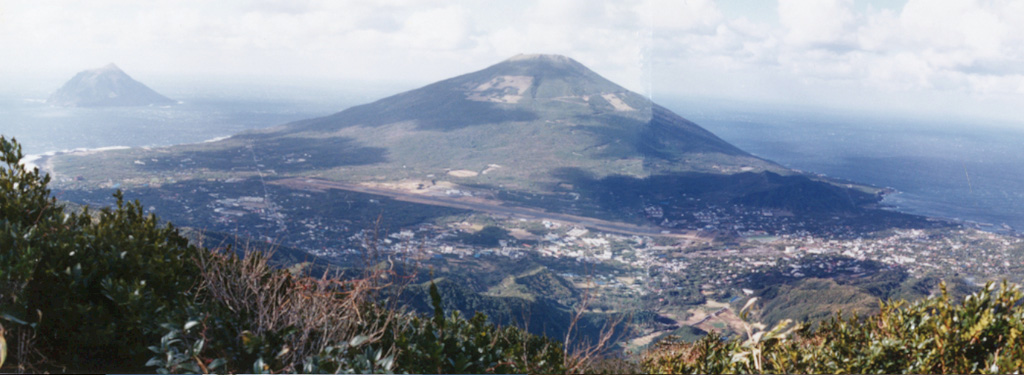
Hachijojima, in the central Izu Islands about 300 km S of Tokyo, consists of two small Quaternary dominantly basaltic stratovolcanoes forming an elongated NW-SE-trending island. The eroded Pleistocene-to-Holocene Higashiyama volcano occupies the SE end of the 14-km-long island. The symmetrical Holocene Nishiyama volcano the NW end has cones on the SE flank. The small volcanic island of Kojima lies several kilometers W of Hachijojima. Growth of Higashiyama began several tens of thousands of years ago, and included the formation of two small calderas. The initial submarine and early subaerial eruptions of Nishiyama took place from 10,000 to 8,000 years before present (BP). Its latest major activity, from the early Holocene until about 4,000 BP, was restricted to flank eruptions. Eruptions recorded since the 15th century have been restricted to the summit of Nishiyama and a submarine vent of unknown location.
Hachijojima Volcano — Japan
Advertisement
Recent earthquakes nearby
- …
Biggest historic earthquakes in the area
- …
Advertisement