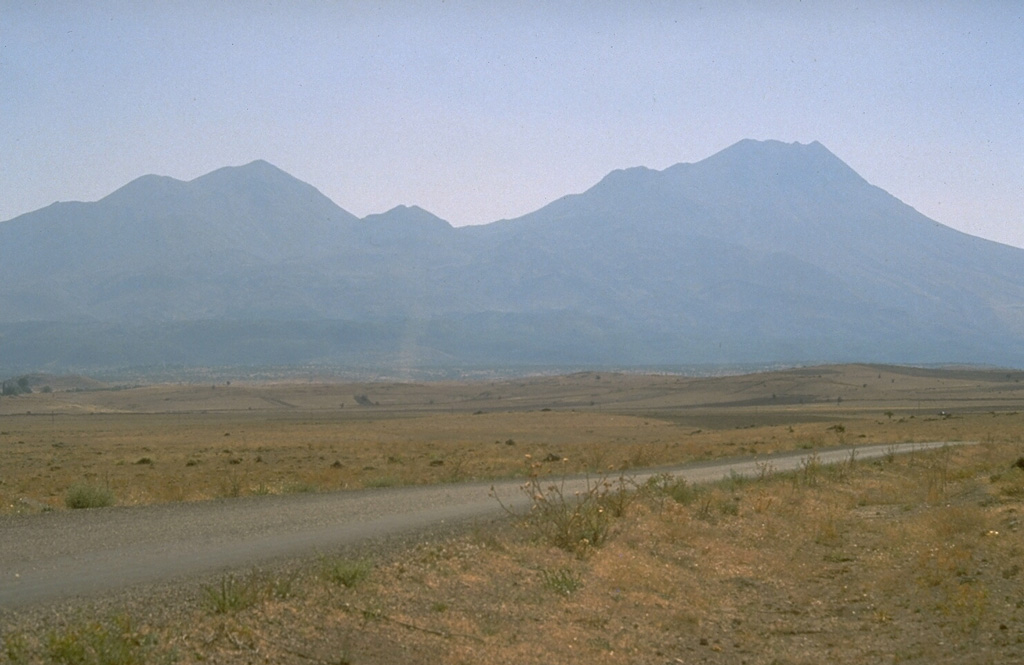
The Hasandag-Keçiboyduran volcanic complex in Central Anatolia includes the massive double-peaked Hasan Dagi stratovolcano, which has undergone four episodes of caldera collapse, the latest of which formed a 4-5 km wide caldera at the summit. The modern edifice within the latest caldera is the youngest of four major basaltic-to-rhyolitic volcanic complexes dating back to the mid-Miocene. Andesitic-to-dacitic lava domes form the two principal summits, of which the westernmost is the highest and is capped by two nested craters. Lava domes and associated pyroclastic-flow deposits cover more than half the flanks. As defined by Uslular et al. (2021), this volcanic field also includes the Pliocene-Quaternary Keçiboyduran stratovolcano, along with numerous monogenetic features: 11 lava domes (andesitic to rhyolitic), 33 scoria cones (basaltic), one maar (basaltic), and 34 undifferentiated features. Interpretations of Neolithic paintings representing eruptions are controversial, but geologic evidence supports eruptive activity continuing into the Holocene. Uslular et al. (2021) reported a lava dome possibly as young as 9,000 years BP (U-Th/He, citing Friedrichs et al., 2020, and Schmitt et al., 2014).
Hasandag-Keciboyduran Volcanic Complex Volcano — Turkiye
Advertisement
Recent earthquakes nearby
- …
Biggest historic earthquakes in the area
- …
Advertisement