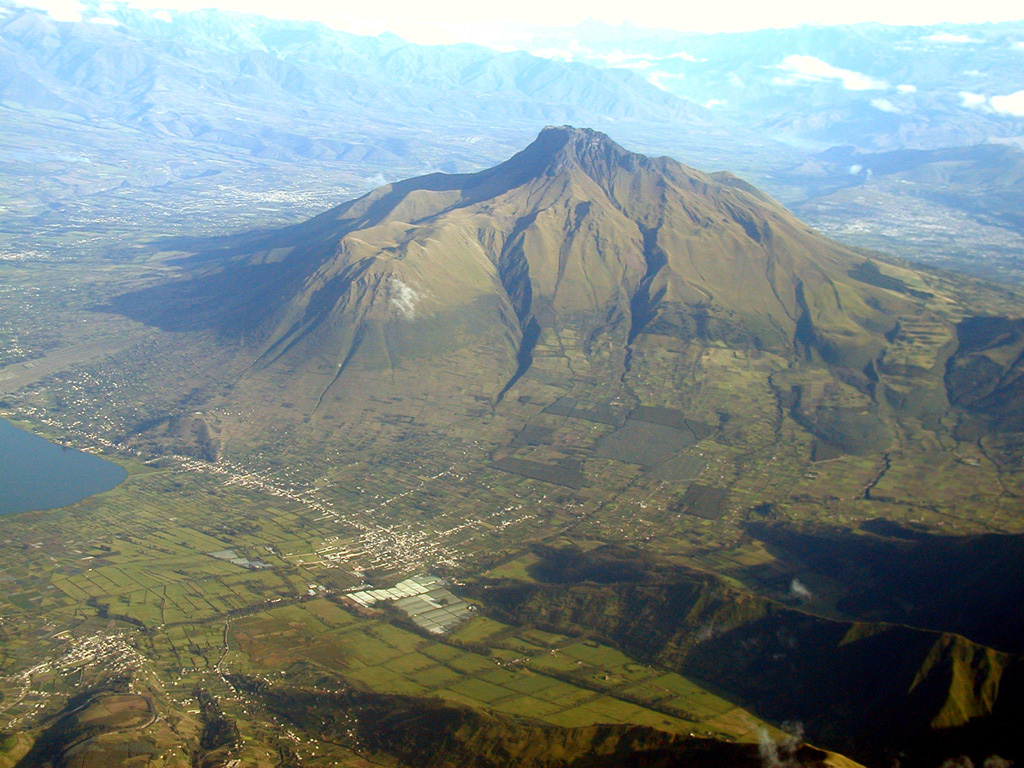
Imbabura volcano rises to the north above scenic Laguna de San Pablo in the Interandean valley about 60 km N of Quito. The main edifice, Taita Imbabura ("Father Imbabura") forms the summit, with Huarmi Imbabura ("Imbabura's Son") forming a lateral lava-dome complex on the SW flank. Activity at the Pleistocene Imbabura I edifice constructed a large andesitic stratovolcano and ended prior to about 43,000 years ago with a major collapse that produced a debris avalanche that traveled 16 km N. Subsequent growth of the Imbabura II stratovolcano continued at least into the early Holocene and typically consisted of growth and collapse of large-volume dacitic lava domes. A major eruption about 25,000 years ago produced a debris avalanche and possible lateral blast and was followed by growth of the Huarmi Imbabura lava dome. Historical reports of eruptions consisted of only mudflows and rock slides.
Imbabura Volcano — Ecuador
Advertisement
Recent earthquakes nearby
- …
Biggest historic earthquakes in the area
- …
Advertisement