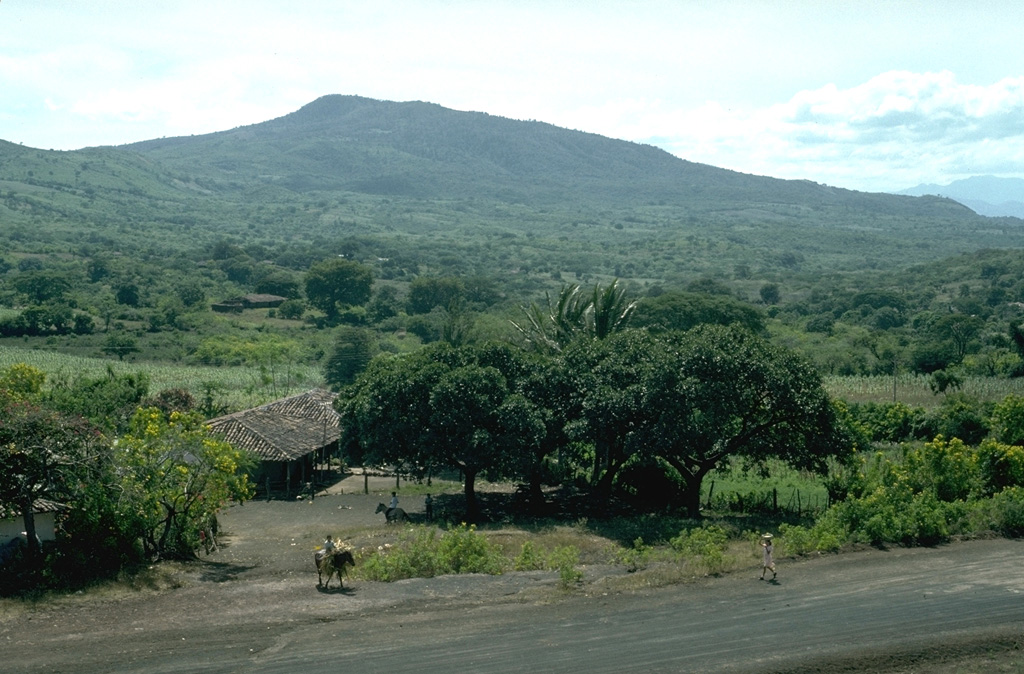
Ixtepeque volcano, which takes its name from the Aztec word for obsidian, is perhaps the largest obsidian field in North America. A 4 x 5 km rhyolitic obsidian lava field was erupted within the Ipala graben from a craterless vent along a NE-trending fissure that passes through adjacent rhyolitic lava domes and basaltic cinder cones. Obsidian from Ixtepeque has shown up at archaeological sites across Central America. Flat-lying pumice beds produced by explosive eruptions preceding lava effusion are found locally around the volcano. Other obsidian flows originated from lava domes NE of Ixtepeque. These rhyolitic vents are interspersed with basaltic cinder cones and lava flows. Laguna de Obrajuelo is a complex cone cut by a large crater more than a km in diameter. Initial basaltic eruptions were followed by the extrusion of obsidian flows and the eruption of rhyolitic pumice that were considered by Williams et al. (1964) to be only a few thousand years old.
Ixtepeque Volcano — Guatemala
Advertisement
Recent earthquakes nearby
- …
Biggest historic earthquakes in the area
- …
Advertisement