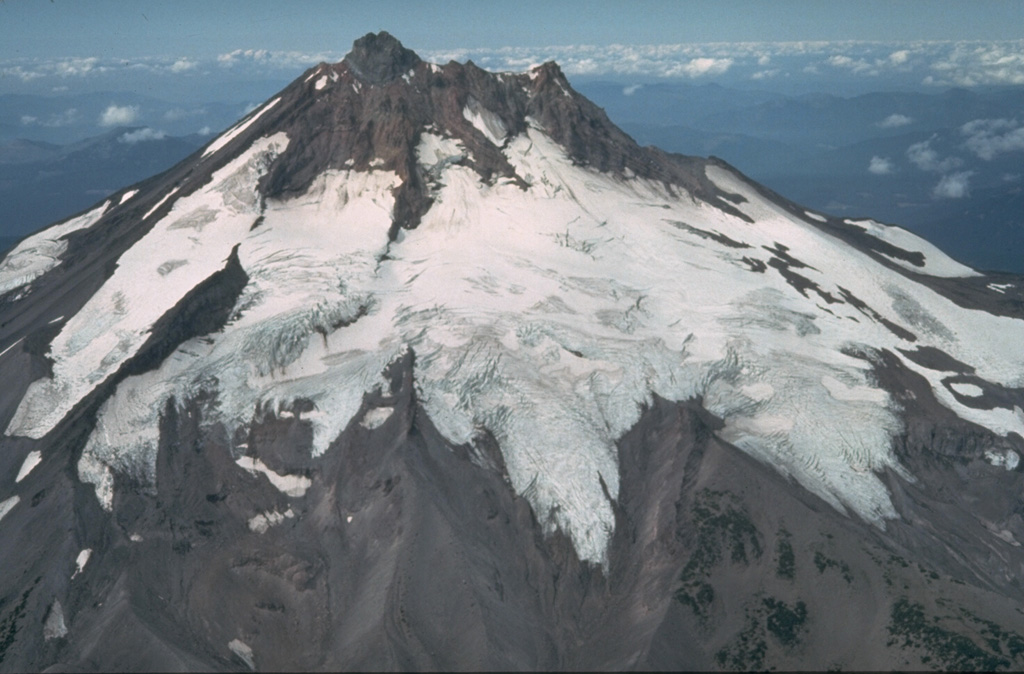
Mount Jefferson, Oregon's second highest peak, is a deeply eroded stratovolcano. The glacier-clad landmark prominent from both sides of the Cascade Range was named by Lewis and Clark for the president that sponsored their expedition. Jefferson was constructed in two episodes interrupted by extensive glacial erosion. The first of these, beginning about 290,000 years ago, produced an andesitic-to-dacitic volcano possibly higher than the current summit. Dacitic lava domes were emplaced during a second cycle beginning about 70,000 years ago which included ash flows that traveled 15 km E and W. Several Holocene cinder cones near the Cascade crest south of Jefferson have produced lava flows that traveled down glacially carved valleys, including those from Forked Butte and North Cinder Peak. The most recent eruption, from a cinder cone on the flank of the South Cinder Peak cone, produced a lava flow that traveled west into Marion Lake about 1,000 years ago.
Jefferson Volcano — United States
Advertisement
Recent earthquakes nearby
- …
Biggest historic earthquakes in the area
- …
Advertisement