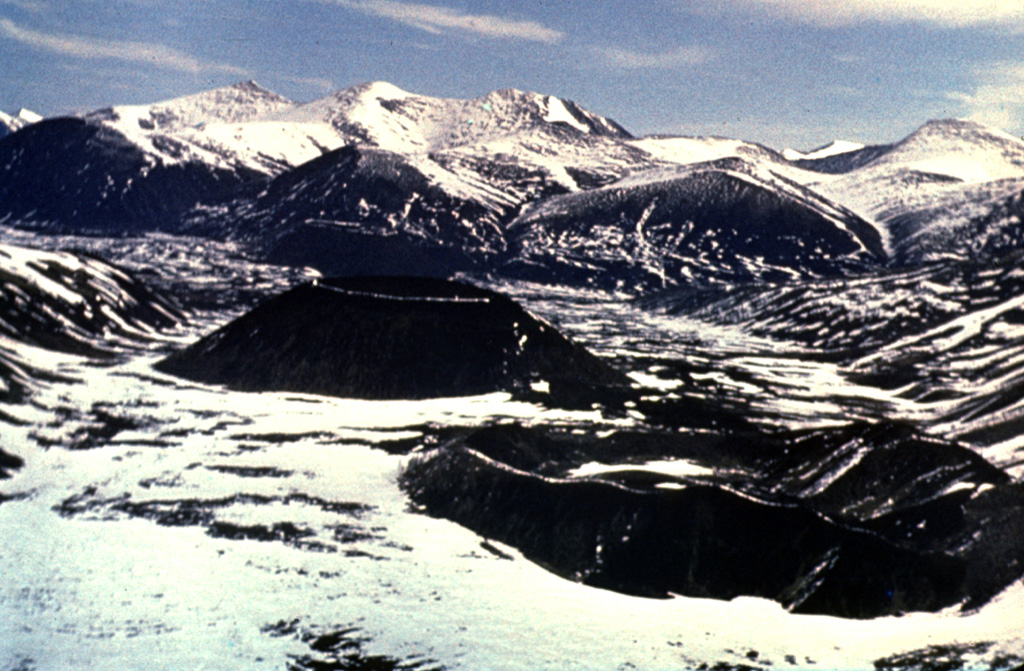
A group of small basaltic cinder cones in the East Sayan region of central Asia, about 200 km WNW of the SW tip of Lake Baikal, produced the Jombolok lava field. Six cones are located along a 5-km-long valley segment. Arzhannikov et al. (2016) defined four stages of activity that began about 13,000 years ago. The Stariy and Treshina cones formed during the first stage, followed by the Peretolchin, Atkinson, and Ostanets cones, which produced basaltic flows down the Jombolok and Oka river valleys to a distance of 75 km. A third stage formed the Kropotkin cone and erupted a smaller volume of lava that extended ~2.5 km NE to the Peretolchin cone along the upper reaches of the Khi-Gol and Kadyr-Os valleys. The fourth stage sent lava flows ~1.7 km SW in the upper Khi-Gol valley, transported through lava tubes from an uncertain source. Ivanov et al. (2011) reported calibrated 14C dates for flows from Atkinson to 5180 BCE. The youngest flows were dated by Arzhannikov et al. (2016) using a combination of 14C, dendrochronology, and historical research to 737 +/- 55 CE.
Jombolok Volcano — Russia
Advertisement
Recent earthquakes nearby
- …
Biggest historic earthquakes in the area
- …
Advertisement