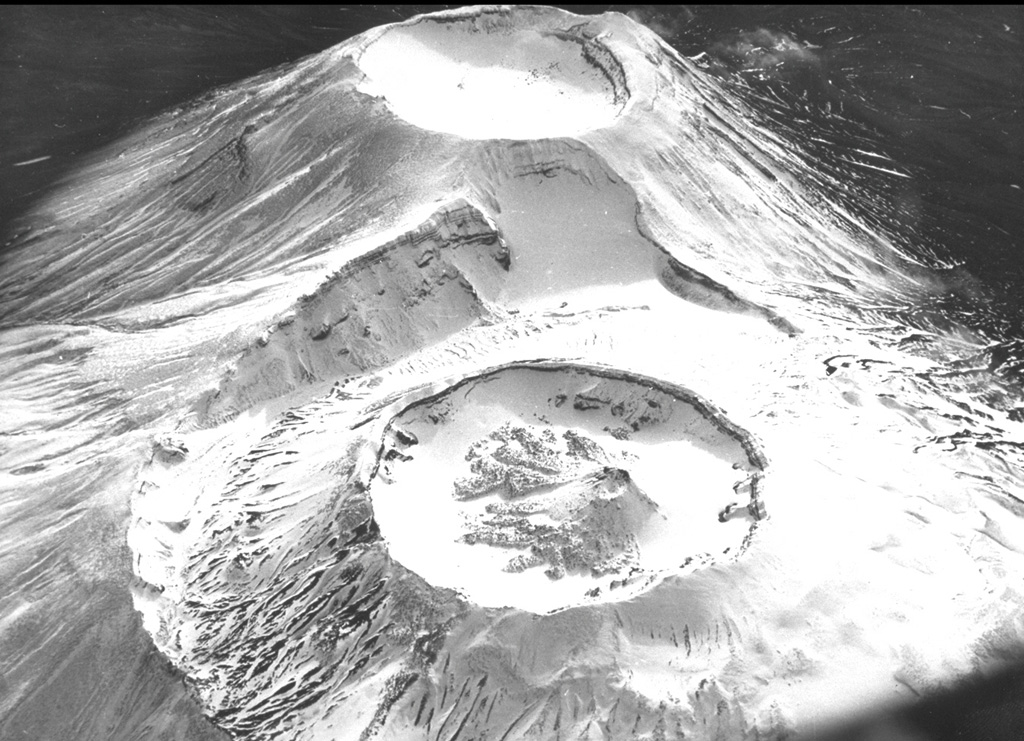
The late Pleistocene to Holocene Krasheninnikov volcano is comprised of two overlapping stratovolcanoes within a 9 x 10 km Pleistocene caldera. Young lava flows from summit and flank vents descend both into the caldera and down its outer flanks, and older flows that covered much of the SE caldera rim extended downslope at least 7 km. Tephra deposits from the caldera-forming eruption directly overlie a 39,000 years before present (BP) tephra thought to be associated with the formation of Uzon caldera (Florenskii, 1988). The intra-caldera stratovolcanoes are situated along a NE-SW-trending fissure that has also produced zones of Holocene cinder cones extending 15-20 km beyond the caldera. Construction of the southern edifice began about 11,000 years BP and lasted for about 4,500 years; it has a summit crater about 800-900 m wide. The northern edifice was constructed during a cycle of similar length that began about 6,500 years ago; it has a summit crater about 1.5 km wide, within which is low cone with an 800-m-wide crater containing another small cone. An eruptive cycle during about 600-400 years BP (1350-1550 CE) produced the Pauk lava cone in the crater of the northern cone and the Yuzhny lava flow on SW flank outside the caldera, followed by the Molodoy flow from the upper SW flank (Ponomareva, 1987; Ponomareva and Tsyurupa, 1985; Ponomareva and Braitseva, 1990).
Krasheninnikov Volcano — Russia
Advertisement
Recent earthquakes nearby
- …
Biggest historic earthquakes in the area
- …
Advertisement