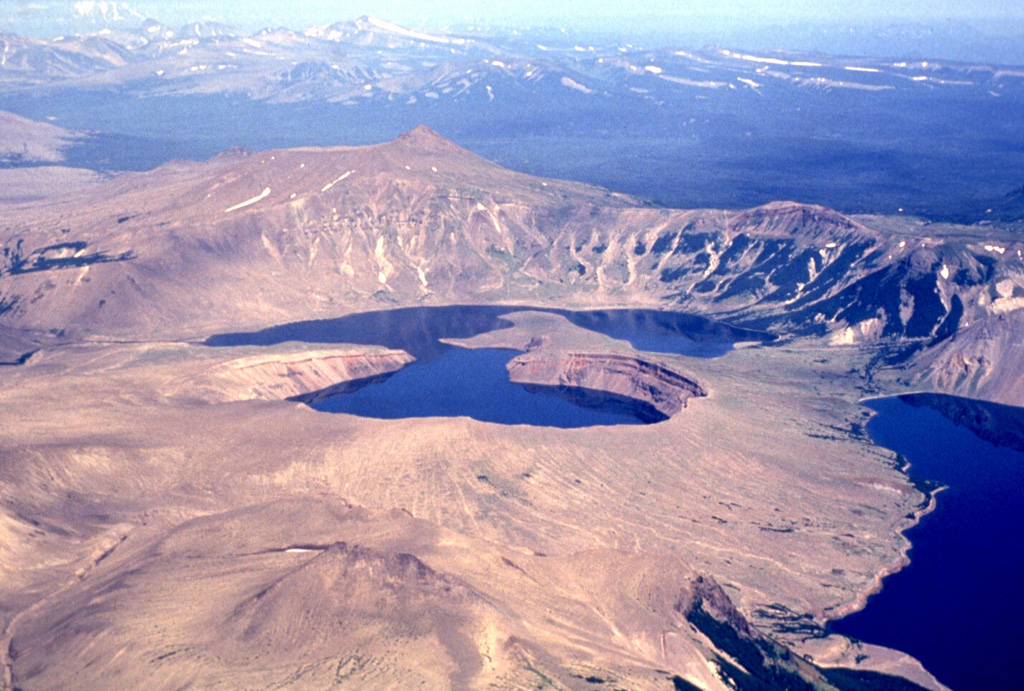
Ksudach is unique among Kamchatka volcanoes in its morphology and geologic history. It is a large, low-angle stratovolcano, constructed of alternating basaltic-andesitic lavas and dacitic pyroclastics, and is truncated by an intricate complex of five calderas. An array of post-caldera structures is truncated by later calderas, the last three of which formed during the Holocene, about 7,900 and 5,000 BCE and about 240 CE. The latter eruption was the second largest in Kamchatka during the Holocene, and produced about 20 km3 of rhyodacitic airfall tephra and 3-4 km3 of pyroclastic flows. The eastern part of the caldera complex contains two lakes, the northern of which forms an embayment in Shtyubel' (Stubel) Crater, a low-angle cone that began forming about 1,600 years ago in the youngest caldera. The only historical eruption, in 1907, originated from Shtyubel'.
Ksudach Volcano — Russia
Advertisement
Recent earthquakes nearby
- …
Biggest historic earthquakes in the area
- …
Advertisement