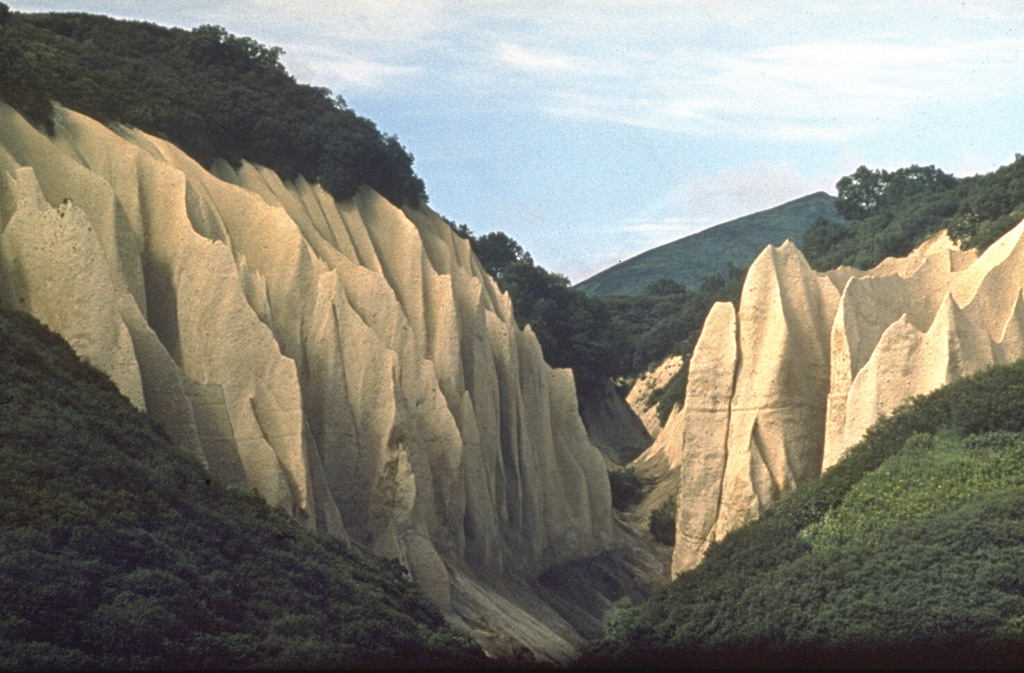
Kurile Lake caldera lies within the eastern part of the massive Pauzhetka caldera, but is considered as a separate volcanic system here. The low-rimmed caldera was formed in two stages during the late Pleistocene and early Holocene. The first caldera-forming eruption took place about 41,500 radiocarbon years ago. The second episode of caldera formation occurred about 7,600 radiocarbon years ago during one of the largest known Holocene eruptions. A total of 140-170 km3 of material was ejected, and extensive thick pyroclastic-flow deposits from the caldera-forming eruptions cover the area. Ash fell more than 1,000 km away on mainland Asia. The eruption resulted in the formation of an 8 x 14 km caldera, now largely filled by Kurile Lake. The steep-sided Serdtze Alaida (Heart of Alaid), which forms a small island rising 300 m from the caldera floor in the center of the lake, is a rhyodacitic lava dome that formed at the end of the caldera-forming eruption.
Kurile Lake Volcano — Russia
Advertisement
Recent earthquakes nearby
- …
Biggest historic earthquakes in the area
- …
Advertisement