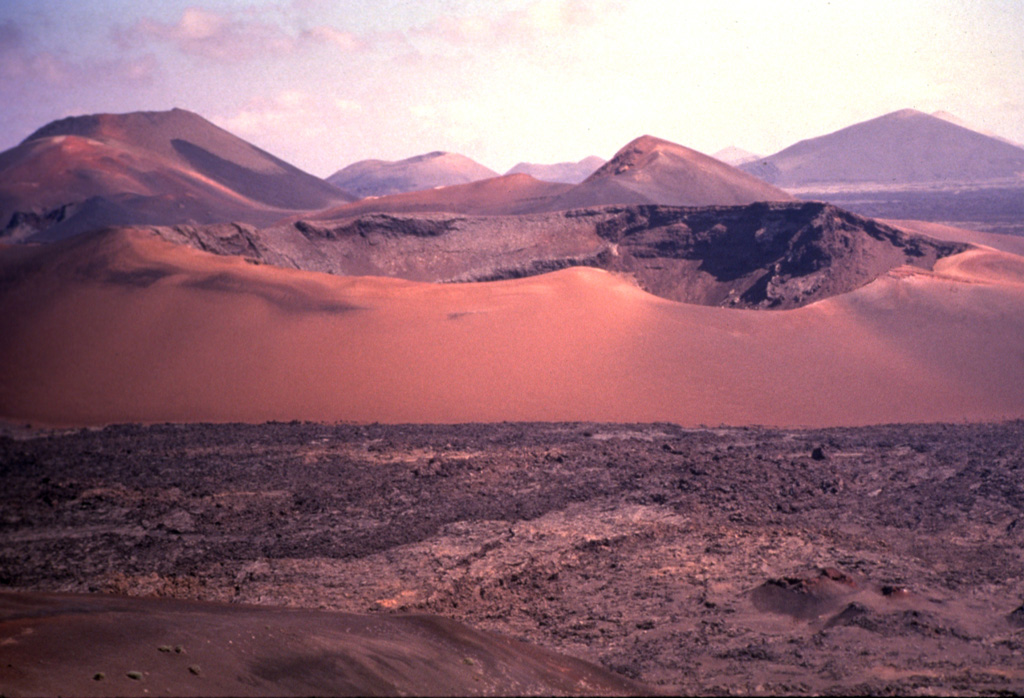
The 60-km-long island of Lanzarote at the NE end of the Canary Islands contains the largest concentration of youthful volcanism in the Canaries. Pleistocene-and-Holocene cinder cones and lava flows erupted along NE-SW fissures are found throughout the low-altitude arid island and on smaller islands to the north. The largest historical eruption of the Canary Islands took place during 1730-36, when long-term eruptions from a fissure formed the Montañas del Fuego and produced voluminous lava flows that covered about 200 km2. The lava flows reached the western coast along a broad, 20-km-wide front. The villages of Maretas and Santa Catalina were destroyed, along with the most fertile valleys and estates on the island. An eruption during 1824 produced a much smaller lava flow that reached the SW coast.
Lanzarote Volcano — Spain
Advertisement
Recent earthquakes nearby
- …
Biggest historic earthquakes in the area
- …
Advertisement