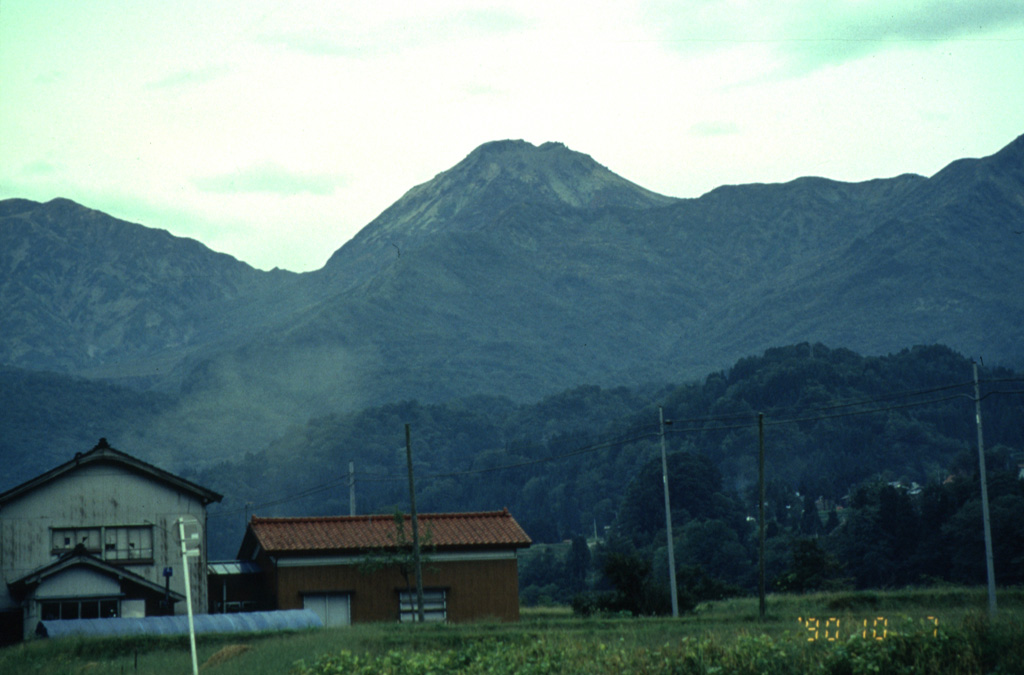
Niigata-Yakeyama, one of several Japanese volcanoes named Yakeyama ("Burning Mountain"), is an andesitic-to-dacitic lava dome in Niigata prefecture in west-central Honshu, about 20 km from the coast. The volcano was constructed on a base of Tertiary mountains beginning about 3,100 years ago. Three major eruptions in the past 1,000 years have produced pyroclastic flows and lava flows that traveled mainly down the Hayakawa river valley to the N and NW. The first of these eruptions, in 887 CE (and possibly 989 CE), produced the Hayakawa pyroclastic flow, which reached the coast, and the massive Mae-yama lava flow, which traveled about 6.5 km down the Hayakawa river valley. The summit lava dome was emplaced during the 1361 CE eruption, and the last magmatic eruption took place in 1773 CE. Eruptive activity since 1773 has consisted of relatively minor phreatic explosions from several radial fissures and explosion craters that cut the summit and flanks of the dome.
Niigata-Yakeyama Volcano — Japan
Advertisement
Recent earthquakes nearby
- …
Biggest historic earthquakes in the area
- …
Advertisement