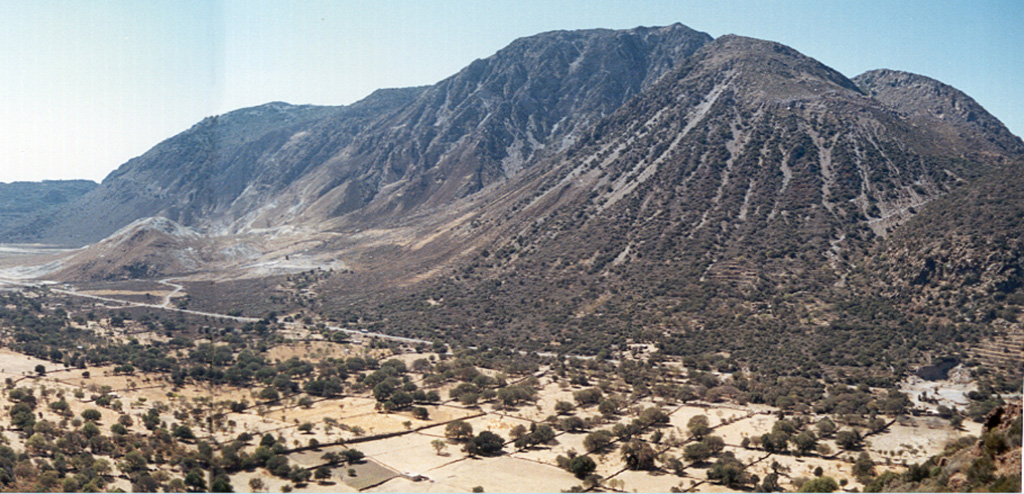
The easternmost volcano of the Aegean arc forms the 9-km-wide island of Nisyros, which is truncated by a 3-4 km wide caldera. The island was constructed during the past 150,000 years, with three cone-building stages including explosive and effusive andesitic eruptions and effusive and extrusive dacitic and rhyolitic activity. The age of the caldera is variously considered to be less than 24,000 years before present (BP) (Keller et al., 1990) and older than 44,000 years BP (Limburg and Varekamp, 1991). Five large post-caldera lava domes completely fill the western part of the caldera. The NE-most (Boriatiko) and SW-most (Karaviotis) lava domes and flows are significantly younger than the other domes. A sixth post-caldera dome, outside the SW caldera rim, produced lava flows that reached the coast. Historical phreatic eruptions occurred from craters within the caldera between 1422 and 1888. Intense hydrothermal activity continues in the form of many fumaroles on the caldera floor and hot springs along the coast.
Nisyros Volcano — Greece
Advertisement
Recent earthquakes nearby
- …
Biggest historic earthquakes in the area
- …
Advertisement