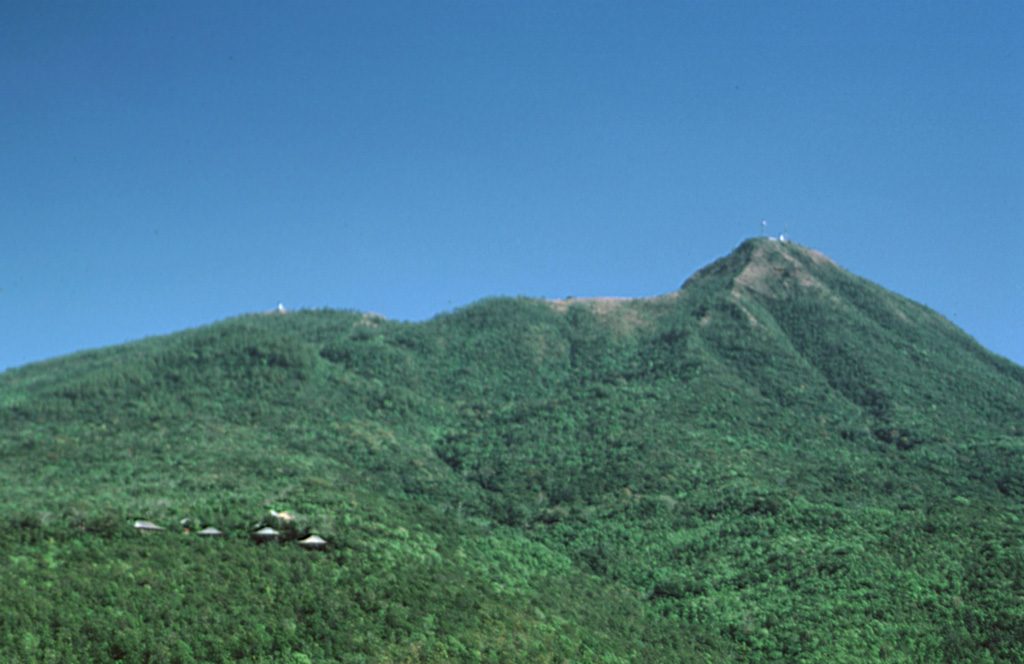
Mount Popa, in central Burma (Myanmar), is a large, steep-sided composite cone that rises above a surrounding lava plateau. The main edifice consists of overlapping basaltic and basaltic andesite lava flows, pyroclastic deposits, and scoriaceous material originating from Strombolian eruptions that may have dominated later stages of the volcano's growth. A 1.6-km-wide, 850-m-deep crater is widely breached to the NW as a result of slope failure. A debris avalanche deposit (3 km3) covers an area of 27 km2 N of the breach. The pyroclastic flow and debris avalanche deposits overlie a paleosol 14C dated around 8,500 cal BP, so Belousov et al. (2018) placed the last eruption at approximately 8,000 cal BP. Local legends describe "a great earthquake" when the cone of Popa "rose from the plains" in 442 BCE (Belousov et al., 2018, citing Bell, 1907), but there is no physical evidence of an eruption that recent. The steep Taung Kalat lava plug on the WSW flank is famous for the monastery built on top.
Popa Volcano — Burma (Myanmar)
StratovolcanoType
6050 BCELast eruption
1518 mElevation
Burma (Myanmar)Country
Advertisement
Recent earthquakes nearby
- …
Biggest historic earthquakes in the area
- …
Advertisement