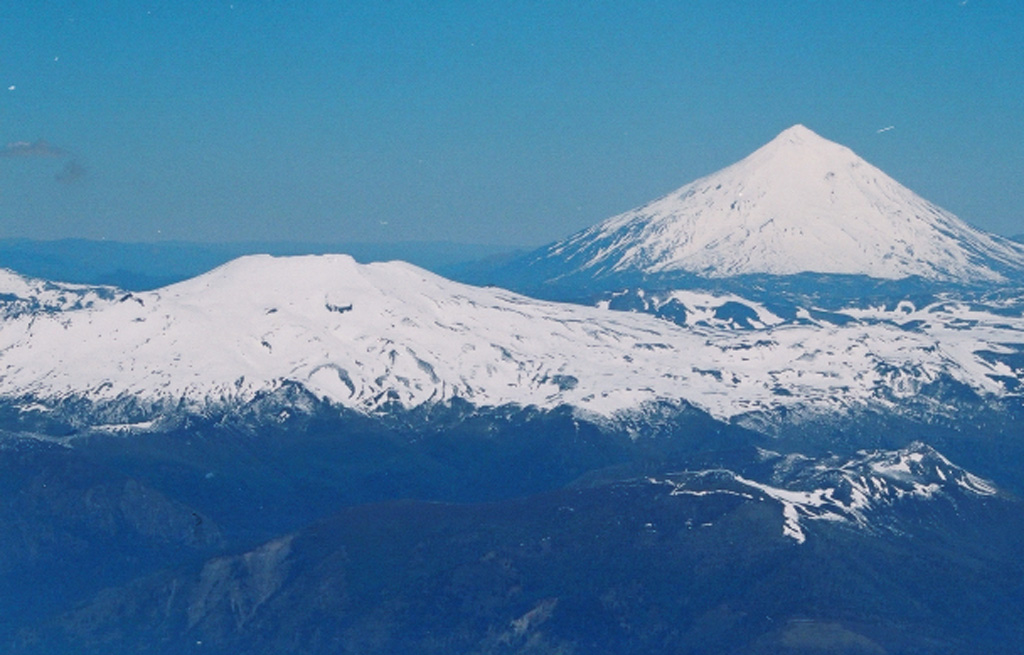
The late-Pleistocene to Holocene Quetrupillán Volcanic Complex is at the center of a group of three volcanoes, with Villarrica and Lanin, trending transverse to the Andean chain. Constructed within a large 7 x 10 km caldera, this glacier-covered volcano contains a 3.5-km-wide caldera and a truncated central cone. Work by Simmons et al. (2020) identified sixteen Holocene vents and their associated lavas around the lower flanks; compositions were dominantly trachyte, with one basaltic andesite eruption and two of trachyandesite. While each vent could represent a distinct eruption, and no absolute dates are available, Simmons et al. (2020) suggested that there had been about 10 eruptive periods associated with the vents, and that evidence of Holocene activity that had constructed the main cone had been removed by ice advances and retreats during the Little Ice Age. Four Holocene pumice lapilli deposits were identified by Fontijn et al. (2016) as originating from Quetrupillán, with compositions ranging from rhyolite to dacite. Other nearby volcanic features include a basaltic scoria cone 12 km NE, a rhyolitic lava dome on the S flank of the caldera, and both scoria cones and basaltic andesite lava flows about 15 km S. An eruption was reported in 1872 (Petit-Breuilh, pers. comm. 2004; Petit-Breuilh Sepúlveda, 2004), but Simmons et al. (2020) noted that there was no corroboration from multiple independent sources for such an event.
Quetrupillan Volcano — Chile
Advertisement
Recent earthquakes nearby
- …
Biggest historic earthquakes in the area
- …
Advertisement