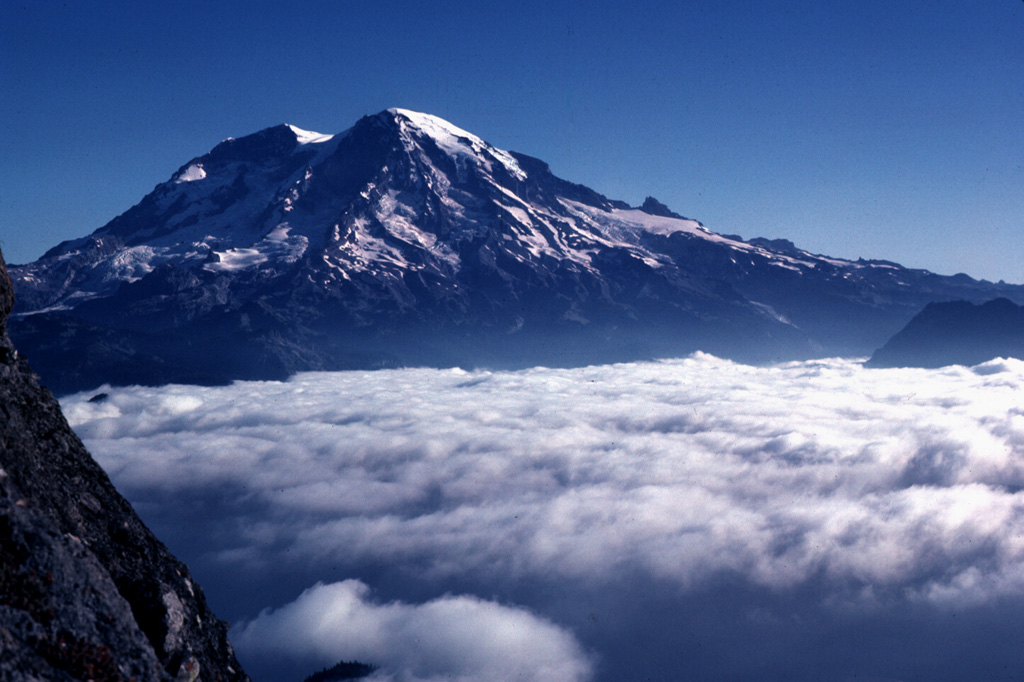
Mount Rainier is a heavily glaciated andesitic volcano in the Puget Sound region. Large Holocene mudflows from collapse have reached as far as the Puget Sound lowlands. The present summit was constructed within a large crater breached to the NE, formed by collapse during a major explosive eruption about 5,600 years ago that deposited the widespread Osceola Mudflow. Rainier has produced eruptions throughout the Holocene, including about a dozen during the past 2,600 years; the largest of these occurred about 2,200 years ago. The present summit cone is capped by two overlapping craters. Extensive hydrothermal alteration of the upper portion of the volcano has contributed to its structural weakness; an active thermal system has caused periodic melting on flank glaciers and produced an elaborate system of steam caves in the summit icecap. Reported uncertain 19th-century eruptions, including a possible but not confirmed phreatic eruption in 1894, have not left identifiable deposits.
Rainier Volcano — United States
Advertisement
Recent earthquakes nearby
- …
Biggest historic earthquakes in the area
- …
Advertisement