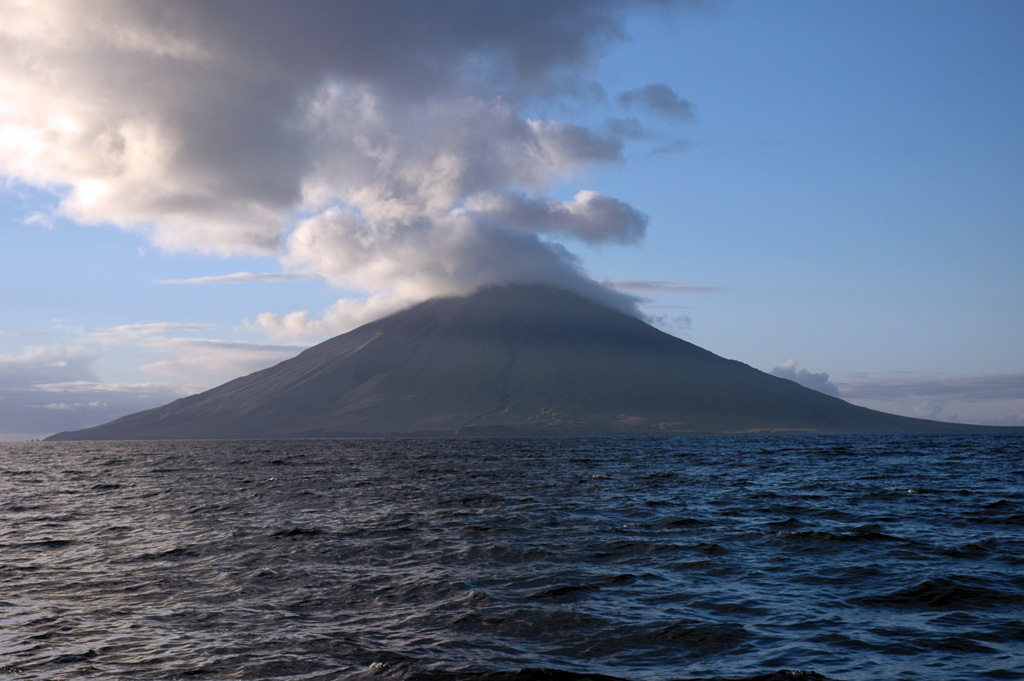
The 6 x 7 km island of Segula east of Kiska volcano consists of a conical stratovolcano cut by a prominent NNW-SSE-trending fissure that extends to sea level at both ends of the island. The northern end of the fissure is flooded by the sea to produce a long, narrow cove. Segula was constructed above a 100-m-deep submarine platform that extends eastward to Khvostof and Davidof islands. A submarine debris-avalanche deposit extends up to 18 km offshore to the north. The summit contains a small, poorly defined caldera that is partly overtopped on the south by a cinder cone that forms the high point of the island and on the north by extensive lava flows that reach the NE coast along a broad front. Another lava field on the SE coast originated from a cinder cone at 300 m elevation on the SE flank. No historical eruptions are known, but Nelson (1959) considered fresh lava flows on the N flank to possibly be only a few hundred years old.
Segula Volcano — United States
Advertisement
Recent earthquakes nearby
- …
Biggest historic earthquakes in the area
- …
Advertisement