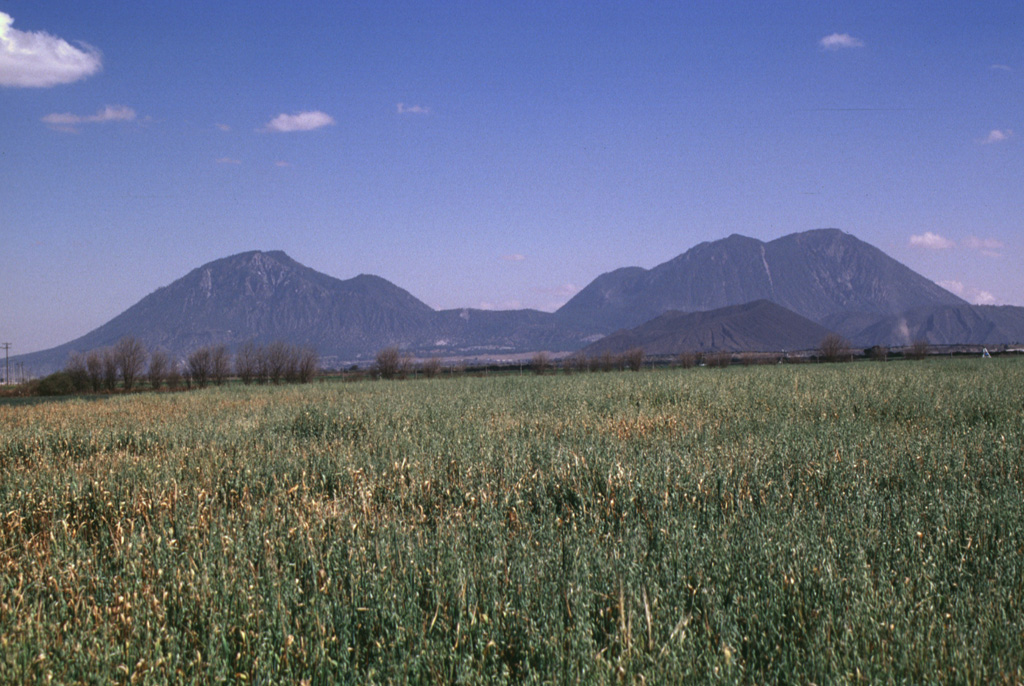
The Serdán-Oriental Volcanic Field, covering an area 35-40 km E-W and 60 km N-S, includes numerous late Pleistocene to Holocene rhyolitic lava domes, tuff cones, tuff rings, lava flows, and scoria cones. Most of the volcanic features are within or adjacent to the a broad closed Serdán-Oriental Basin at the eastern end of the Mexican Altiplano, bounded by the Cofre de Perote-Orizaba range on the east and Los Humeros caldera to the north. A major explosive eruption from a vent inferred to be buried within the basin produced the Quetzalapa Plinian pumice-fall deposit roughly 20,000 years ago. The most prominent features of the volcanic field are the two Las Derrumbadas lava domes surrounded by debris avalanche deposits, and the sharp-peaked Cerro Pizarro lava dome at the northern end of the basin. Several of the tuff rings contain lakes, such as Laguna Atexcac and Laguna Alchichica. Although often associated with Las Cumbres, obsidian domes to the N and SW are included here as part of the Serdán-Oriental regional distributed volcanism. The rhyolitic Yolotepec lava dome, between Las Cumbres and La Gloria, is also included here; it has been radiocarbon dated to ~3900 BCE (5,900 years BP).
Serdan-Oriental Volcanic Field Volcano — Mexico
Advertisement
Recent earthquakes nearby
- …
Biggest historic earthquakes in the area
- …
Advertisement