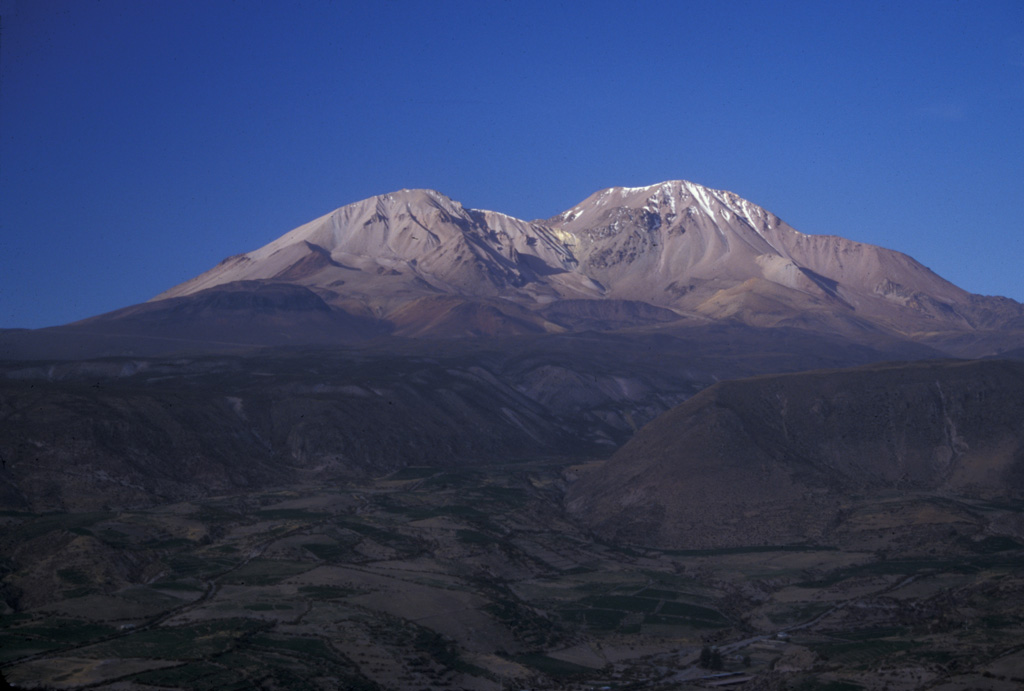
The Taapaca volcanic complex, lying W of the main Andean chain, rises NE of the small town of Putre, the principal settlement of the northern Chilean Altiplano. The elongated volcanic massif, known locally as Nevados de Putre, consists of an andesitic stratovolcano and a dacitic lava-dome complex. It overlies Pleistocene ignimbrite deposits and trends roughly E-W, with activity migrating generally to the SW during four principal periods of activity dating back at least 1.5 million years. At least three major edifice collapse events have produced debris-avalanche deposits, the youngest of which underlies Putre. Studies have shown that explosive activity with dome growth and associated block-and-ash flows and lahars continued into the late Holocene. The youngest volcanic stage, beginning about 9000 years ago, produced the summit lava dome of the Putre Unit at the E and S ends of the complex. The latest documented activity produced an ash layer dated ~2000 years ago.
Taapaca Volcano — Chile
Advertisement
Recent earthquakes nearby
- …
Biggest historic earthquakes in the area
- …
Advertisement