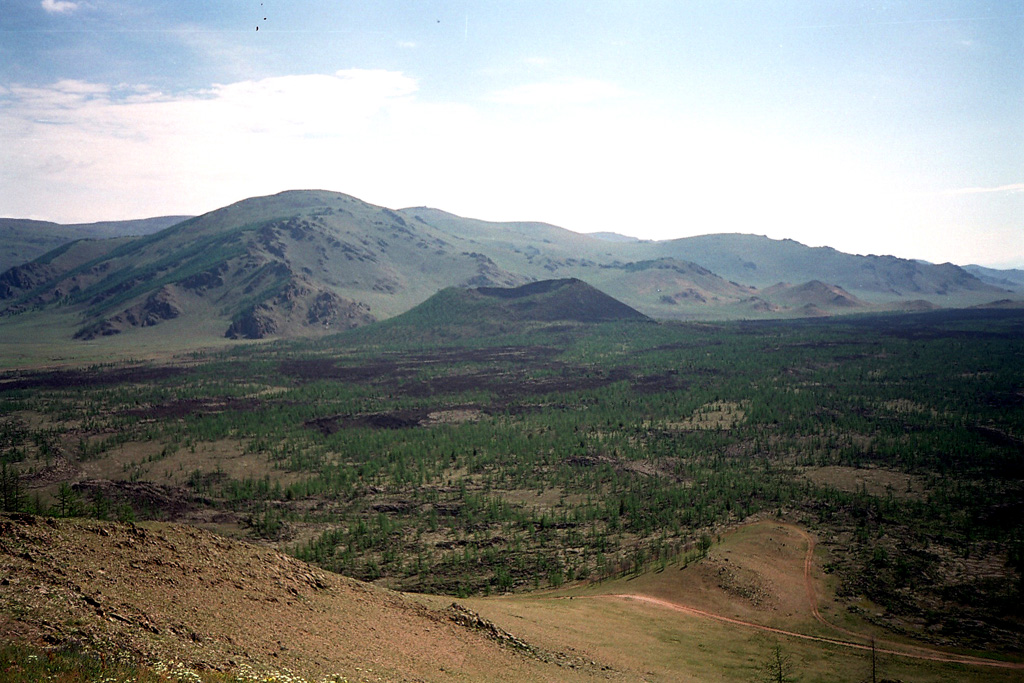
The Taryatu-Chulutu volcanic field lies in north-central Mongolia about 250 km W of Ulaanbaatar. This area, also known as the Hangayn or Tariat volcanic field, is located in a broad region of Miocene-to-Holocene basaltic lavas in the Baikal Rift System SSW of Lake Baikal. Lava flows of four Miocene-to-Holocene age groups form terraces along the Chulutu (Chuloot) River; Pleistocene basalts form the 40-60 m terrace of the Taryatu basin. Six Holocene cinder cones, including Horgo and Dzan Tologai, are concentrated along the Sumein and Gichgeniyn river valleys at the western end of the volcanic field. The 180-m-wide crater of Horgo is breached to the south, in the direction of an associated lava flow. The Holocene cones produced thin, freshly preserved lava flows remarkable for their large numbers of ultramafic xenoliths. The lava flow from Horgo was radiocarbon dated at about 4,930 years ago and dammed the Chulutu River, forming Lake Terkhin-Tsagan-Nur.
Taryatu-Chulutu Volcano — Mongolia
Volcanic fieldType
2980 BCELast eruption
2326 mElevation
MongoliaCountry
Advertisement
Recent earthquakes nearby
- …
Biggest historic earthquakes in the area
- …
Advertisement