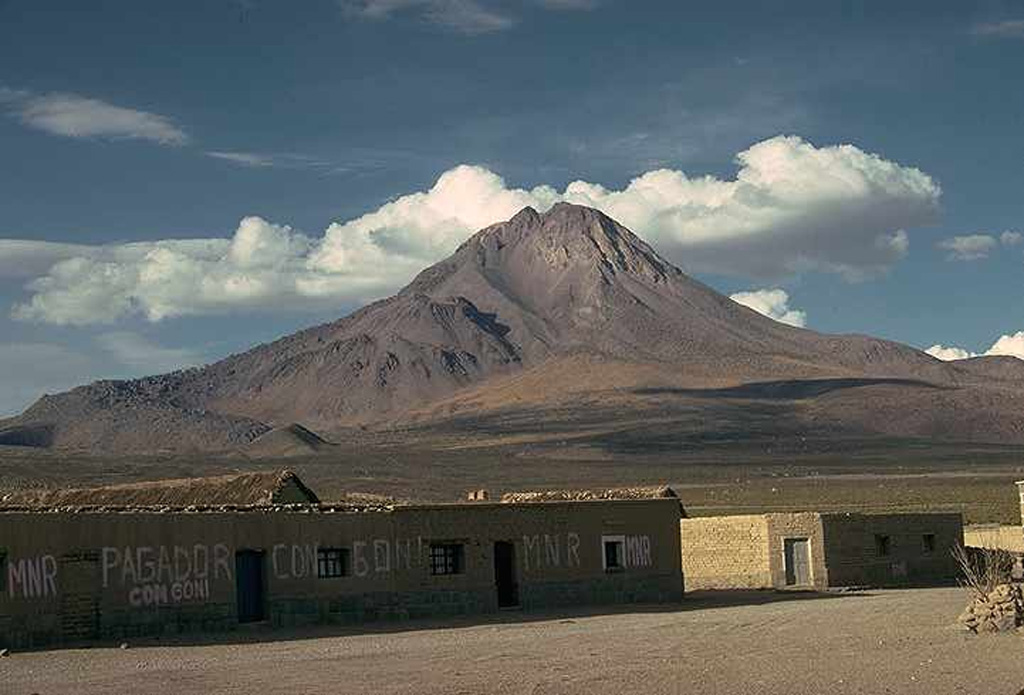
The symmetrical Tata Sabaya towers above the northern end of the Salar de Coipasa in the Altiplano of Bolivia. A pyroclastic shield capped by lava domes was topped by effusive eruptions that formed the unglaciated andesitic stratovolcano. Collapse of this edifice produced a large late-Pleistocene debris avalanche that swept into the Salar de Coipasa and covered an area of more than 300 km2 S of the volcano, traveling up to 30 km. Tufa deposits on avalanche hummocks correspond to a ~12,000 year old high stand of the lake. Renewed eruptions during the Holocene constructed lava domes and flows that have restored much of the original edifice. Youthful lava flows extend down the NW and W flanks, and pyroclastic-flow deposits from partial collapse of the summit dome extend to the lower SW flank.
Tata Sabaya Volcano — Bolivia
StratovolcanoType
HoloceneLast eruption
5430 mElevation
BoliviaCountry
Advertisement
Recent earthquakes nearby
- …
Biggest historic earthquakes in the area
- …
Advertisement