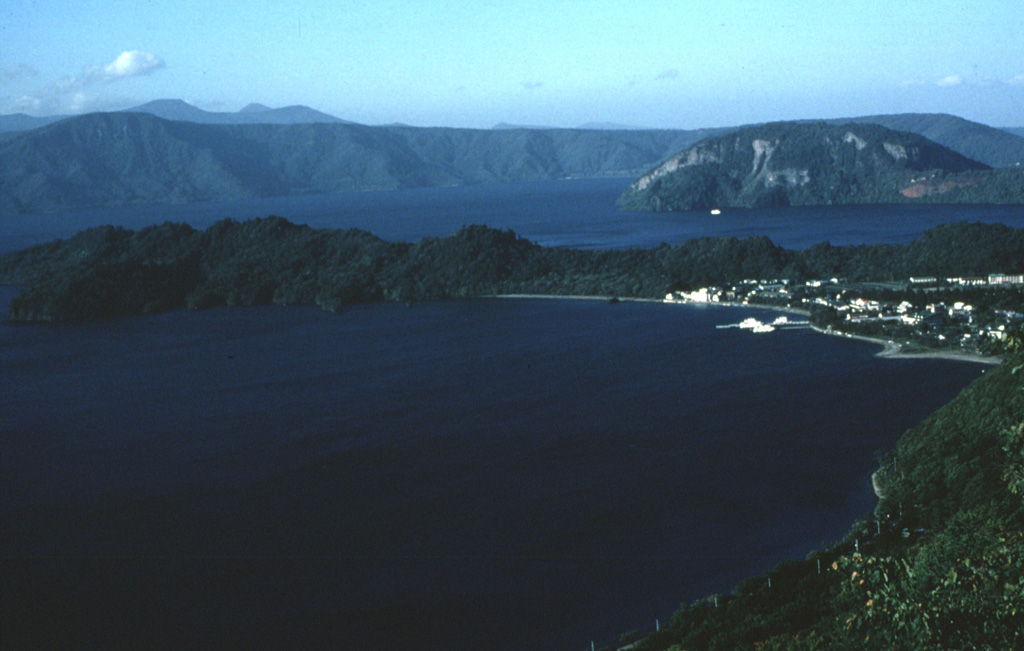
The lake-filled, 11-km-wide, Towada caldera in northern Honshu formed during as many as six major explosive eruptions over a 40,000-year period ending about 13,000 years ago. Pre-caldera eruptive activity dates back about 2 million years and produced basaltic-to-dacitic lava cones. Following late-Pleistocene andesitic-to-rhyolitic caldera-forming eruptions, the basaltic Ninokura stratovolcano grew in the SSE section of the caldera. Successive dacitic-to-rhyolitic explosive eruptions from the Goshikiiwa cone led to the formation of the roughly 2-km-wide Nakanoumi caldera, whose SW and NE rims form peninsulas extending into Lake Towada. The andesitic-to-dacitic Ogurayama lava dome was built over the NE rim of Nakanoumi. The latest eruption took place in 915 CE, when eruptions from Ogurayama produced widespread ashfall and pyroclastic flows.
Towada Volcano — Japan
Advertisement
Recent earthquakes nearby
- …
Biggest historic earthquakes in the area
- …
Advertisement