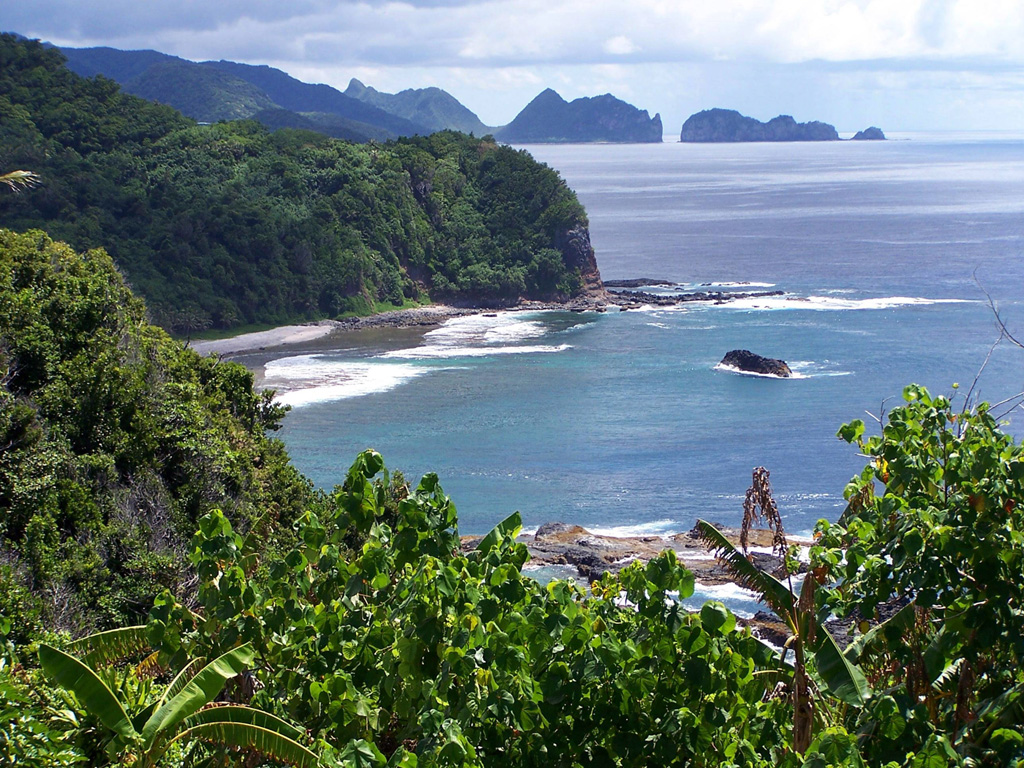
The elongated, extensively eroded Tutuila Island in the center of the Samoan Islands consists of five Pliocene-to-Pleistocene volcanoes constructed along two or three rifts trending SSW-NNE. The Pago basaltic-to-andesitic shield volcano in the center of the 32-km-long island is truncated by an eroded, 9-km-wide caldera that encloses Pago Pago harbor on its west. The caldera is now partially filled by cinder cones and trachytic lava domes. ENE-trending dike complexes are prominently exposed on Pago volcano. Following a lengthy period of erosion, submergence, and the construction of a barrier reef, the Leone Volcanics were erupted during the Holocene along a 5-km-long N-S-trending fissure over a broad area at the southernmost part of the island (Stearns, 1944), forming a group of initially submarine tuff cones and subsequent subaerial cinder cones that produced fresh-looking pahoehoe lava flows. An ash layer overlying a cultural deposit in the SW part of the island was radiocarbon dated at about 440 +/- 200 CE (Addison et al., 2006).
Tutuila Volcano — United States
Advertisement
Recent earthquakes nearby
- …
Biggest historic earthquakes in the area
- …
Advertisement