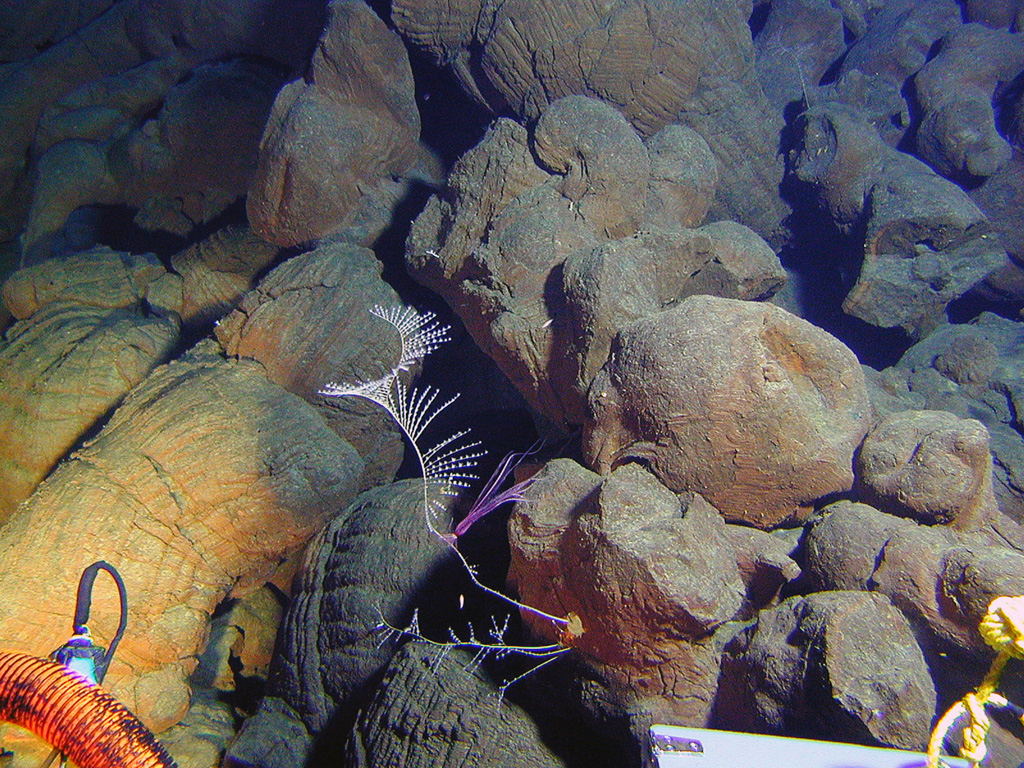
Vailulu'u, a massive basaltic seamount discovered in 1975, rises 4,200 m from the sea floor to a depth of 590 m. Located about one-third of the way between Ta'u and Rose islands at the E end of the American Samoas, it is considered to mark the current location of the Samoan hotspot. The summit contains an oval-shaped crater that is 2 km wide and 400 m deep. Two principal rift zones extend E and W from the summit, parallel to the trend of the hotspot; a third rift extends SE. The rift zones and escarpments produced by mass wasting phenomena give the seamount a star-shaped pattern. On 10 July 1973 explosions were recorded by SOFAR (hydrophone records of underwater acoustic signals). An earthquake swarm in 1995 may have been related to an eruption. Eruptive activity between April 2001 and April 2005 formed a cone almost 300 m high, named Nafanua. Repeated bathymetric mapping surveys showed depth changes, including height and width increases of Nafanua after 2005, that suggest at least intermittent activity during 1999-2017; a 2019 survey showed no further changes since 2017.
Vailulu'u Volcano — United States
Advertisement
Recent earthquakes nearby
- …
Biggest historic earthquakes in the area
- …
Advertisement