
What is earthquake depth?
Every earthquake starts at a specific point underground where rock first fractures and slips along a fault. Seismologists call this point the hypocenter (or focus). The depth of the hypocenter below the Earth's surface — measured in kilometres — is what we mean by earthquake depth.
The point directly above the hypocenter on the surface is called the epicenter, which is the location you see reported on maps. But depth is the hidden variable that often determines how badly a quake is felt, how much shaking reaches the surface, and how large an area is affected.
How seismologists measure depth
Seismic networks record the waves an earthquake generates and transmit the data in real time to processing centres like the USGS National Earthquake Information Center. Depth is calculated by analysing the arrival times of different wave types — primarily P-waves (compressional) and S-waves (shear) — at multiple recording stations spread across different distances from the epicenter.
The difference in travel time between wave types, combined with the known velocity of seismic waves through different rock layers, lets computers triangulate not just the epicenter's horizontal position but also the depth. The method is well-established, though for very shallow quakes (less than 5 km) the uncertainty can be significant, and for events at sea or in remote areas with few nearby stations the depth estimate may carry larger errors.
For deep earthquakes, additional clues come from the way energy radiates outward: deep events generate a distinctive pattern of waveforms that shallow ones do not. The USGS and other agencies continuously refine depth estimates as more data come in, which is why you sometimes see the listed depth of a quake revised in the hours after it occurs.
The three depth categories
Seismologists divide earthquakes into three broad categories based on depth:
- Shallow earthquakes (0–70 km): The most common and, per unit of magnitude, the most destructive. The released energy travels a short distance to the surface with little loss, so even a moderate-magnitude quake can cause severe shaking at the epicenter.
- Intermediate earthquakes (70–300 km): Common in subduction zones as a slab descends. They can produce strong shaking over a wide area because the longer travel distance allows energy to spread, but peak shaking near the epicenter is typically less intense than for a shallow quake of the same magnitude.
- Deep earthquakes (300–700 km): The deepest quakes ever recorded have occurred at around 660 km. By the time their energy reaches the surface it has been distributed over a huge volume of rock, so the shaking is rarely catastrophic even for large magnitudes — but it can be felt across enormous distances.
Why shallow earthquakes are more dangerous
Imagine dropping a stone into water. Drop it from 1 cm above the surface and the ripples are concentrated and powerful. Drop it from a metre and the energy has already spread before it hits. Earthquake energy works in a similar way: when the source is close to the surface, the seismic waves have almost no time to spread before they arrive at buildings and people.
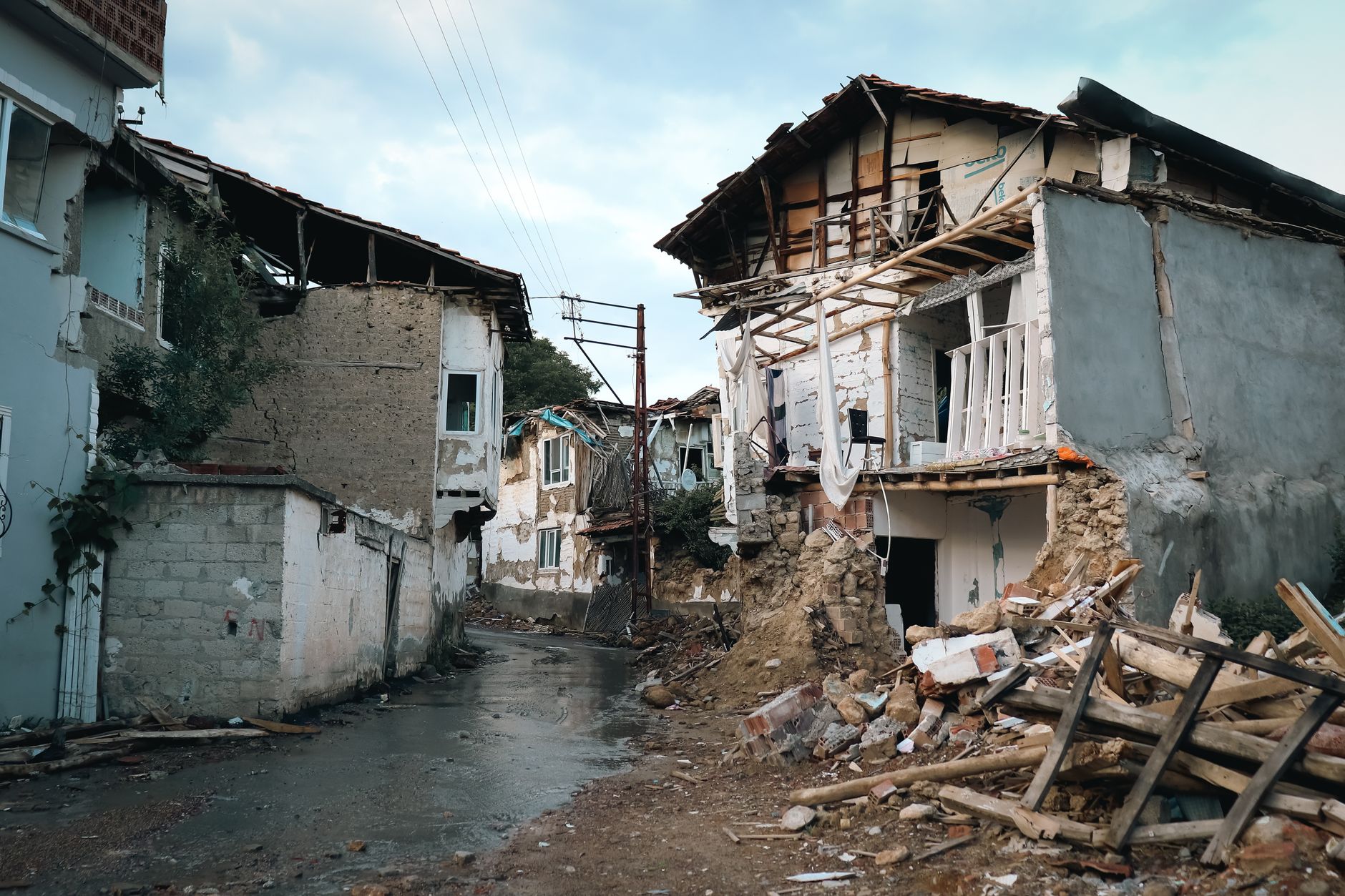
The 2011 Lorca earthquake in Spain is the clearest European example. It was only magnitude 5.1 — modest by global standards — but it struck at a depth of just 1 km, directly beneath the town. Nine people died and hundreds of older masonry buildings were damaged or destroyed. A quake of the same magnitude at 15 km depth might have gone largely unnoticed.
Similarly, the 2010 Haiti earthquake (M7.0) struck at about 13 km depth right under Port-au-Prince, and the 2023 Turkey–Syria earthquakes (M7.8) ruptured a fault at depths starting around 10–18 km beneath a densely populated region. In both cases, shallow depth amplified what was already a powerful event into a catastrophic one.
Deep earthquakes: science, not destruction
Deep earthquakes are scientifically fascinating because, at depths below roughly 300–400 km, the pressure and temperature are so high that rocks should theoretically flow rather than fracture. How brittle fracture — which is what an earthquake requires — can occur at those depths is a question seismologists have studied for decades. Two main mechanisms are proposed: dehydration embrittlement (where fluids released from descending minerals weaken the rock) and transformational faulting (where a mineral phase change produces a volume collapse that acts like a fracture).
The deepest recorded earthquakes, some reaching 660 km, occur primarily in subduction zones — notably the Tonga, Marianas, and Japan trenches — where cold oceanic plates descend rapidly enough to retain some of their brittleness at great depth.
Because deep quakes radiate energy through so much rock, they rarely cause casualties even when their magnitudes exceed 7.0 or 8.0. A magnitude 8.3 quake struck deep under the Sea of Okhotsk in 2013 at 609 km depth; it was felt across Russia and Asia but caused no damage. This is almost the opposite situation from Lorca.
Depth on the QuakeBeat live map
Every earthquake listed on the QuakeBeat live map shows depth alongside magnitude. Look for the depth figure in kilometres. As a quick rule of thumb: if a quake occurs at less than 20 km depth in or near a populated area, it deserves closer attention regardless of its magnitude. Anything below 100 km is unlikely to cause significant surface damage unless the magnitude is very large.
Depth is also relevant for tsunami generation. Tsunamis are most commonly triggered by shallow, large-magnitude quakes on subduction zones where the seafloor is abruptly displaced vertically. Deep earthquakes rarely generate tsunamis for the same reason they rarely cause surface damage: the displacement does not efficiently propagate upward through hundreds of kilometres of rock.
The relationship between depth and aftershocks
Shallow earthquakes tend to produce more numerous and longer-lasting aftershock sequences than deep ones. After the fault ruptures near the surface, the surrounding crust — which is cold and brittle — adjusts gradually over weeks or months, producing a series of smaller events. The Lorca 2011 aftershock sequence, for example, continued for several months. After deep earthquakes, aftershock sequences are usually shorter and smaller relative to the main shock, partly because the ambient pressure at depth makes fault re-rupture less likely.
For communities affected by a shallow quake, this has a practical implication: the immediate danger is not over when the main shock ends. Structures weakened by the first event may collapse during aftershocks, which is why post-earthquake inspections of damaged buildings are critical before people return.
Key takeaways
Earthquake depth — the distance from the surface to the point of rupture — is as important as magnitude when assessing the impact of a quake. Shallow events (under 70 km) are far more dangerous per unit of magnitude because their energy reaches the surface before it can spread. Deep earthquakes are scientifically important but rarely catastrophic at the surface. On any live earthquake map, always check both magnitude and depth together for the clearest picture of what to expect.