When a cluster of earthquakes hits the same area, news reports reach for three different words — foreshock, aftershock, swarm — often without explaining what separates them. The difference is not about size or damage; it is about sequence and pattern, and it shapes how seismologists talk about hazard in the days after a big quake.
The mainshock is the anchor
Every sequence is defined relative to its mainshock: the single largest earthquake in a cluster of related events on the same fault system. Everything smaller that happens before it is a foreshock; everything smaller that happens after it is an aftershock. The classification is retroactive and purely about timing and relative size — a magnitude 4.0 is an aftershock of a magnitude 6.5 mainshock, but the same M4.0 would be the mainshock of its own sequence if nothing bigger ever followed it nearby.
Foreshocks: only identified after the fact
A foreshock is a smaller earthquake that precedes a larger mainshock in the same region, close enough in time and location to be considered part of the same sequence. The catch is that foreshocks cannot be identified as they happen — only once the larger mainshock arrives can seismologists look back and relabel the earlier quake. Globally, something like half of large earthquakes are preceded by at least one foreshock, but the overwhelming majority of small earthquakes are never followed by anything larger, so most small quakes are never foreshocks of anything. This is exactly why foreshocks cannot be used to reliably predict a bigger quake is coming; see our guide on whether earthquakes can be predicted for more on why precursors fail as warnings.
Aftershocks: a decaying aftermath
An aftershock is a smaller earthquake that follows the mainshock in the same area, caused by the crust readjusting to the stress the main rupture redistributed along and around the fault. Aftershock rates follow a well-documented statistical pattern called the modified Omori law: they are most frequent in the hours immediately after the mainshock, then decay roughly in proportion to elapsed time — a sequence that produces 100 aftershocks on day one might produce 10 by day ten and 1 by day one hundred, though the exact decay rate (the "p-value") varies by region.
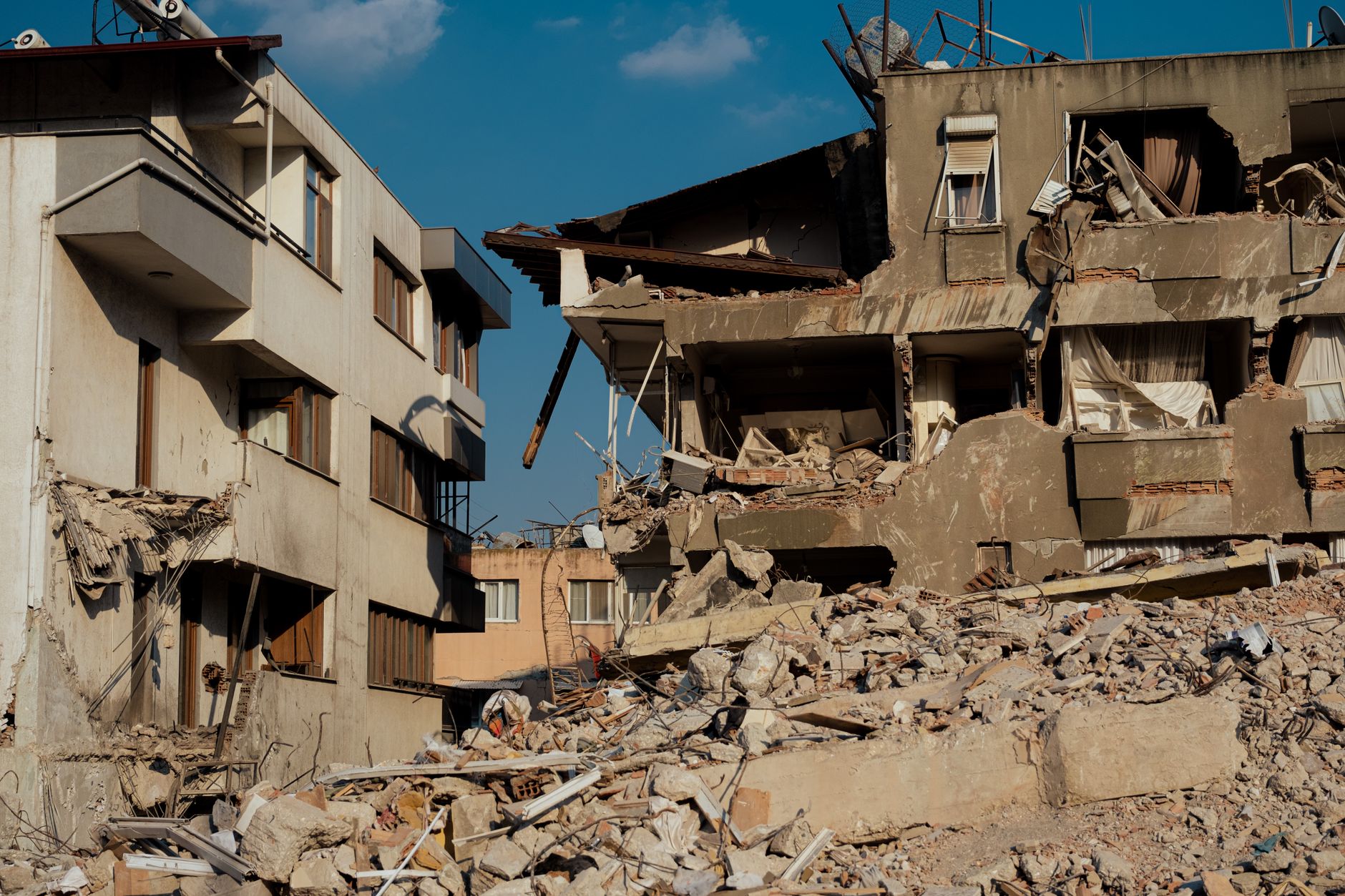
This decay is only a statistical tendency, not a guarantee for any single sequence, and large mainshocks can keep producing felt aftershocks for a surprisingly long time. The M9.0 2011 Tōhoku earthquake off Japan was still generating aftershocks years after the mainshock. The 2015 Nepal earthquake (M7.8) was followed just over two weeks later by a M7.3 aftershock that caused further casualties and damage, a reminder that aftershocks are not always minor by everyday standards even if they are smaller than the mainshock that defines them.
Swarms: no single event in charge
An earthquake swarm breaks the mainshock-aftershock pattern entirely. Instead of one dominant quake followed by progressively smaller ones, a swarm is a cluster of many earthquakes of broadly similar magnitude, packed close together in time and location, without any single event standing out as "the" mainshock. Swarms are especially common in volcanic and geothermal regions — Iceland's Reykjanes Peninsula has produced repeated swarms as magma moved toward the surface in the years around its recent eruptions — because fluid and magma movement underground can repeatedly stress small patches of rock in short bursts rather than releasing accumulated strain in one large rupture.
Why Ridgecrest 2019 shows the whole picture
The July 2019 Ridgecrest, California sequence illustrates how these labels interact in practice. A magnitude 6.4 earthquake struck on 4 July 2019; for just over a day it was treated as a significant earthquake in its own right. Then, about 34 hours later, a magnitude 7.1 earthquake ruptured a nearby, connected fault — larger than the first event. Seismologists immediately reclassified the M6.4 as a foreshock of the new M7.1 mainshock, which went on to produce tens of thousands of its own aftershocks over the following months, some strong enough to cause additional damage on their own.
What this means if you feel a sequence underway
If you feel a moderate earthquake, agencies like the USGS cannot tell you in advance whether it is the mainshock, a foreshock of something bigger still to come, or just one member of a swarm — that only becomes clear in hindsight. What they can do is give you statistical aftershock forecasts (for example, "a 5-10% chance of a quake as large or larger in the next week") based on the decay patterns typical for that fault and region. The practical safety advice is the same regardless of the label: treat the first strong shake as a cue to check for hazards and be ready for more, and follow our earthquake safety guide for what to do during and after the shaking stops.
Frequently asked questions
What's the difference between a foreshock and an aftershock?
A foreshock happens before the largest earthquake in a sequence (the mainshock); an aftershock happens after it, in the same area. The label depends entirely on timing relative to the mainshock, not on the size of the smaller quake itself.
How do seismologists know a quake was a foreshock?
They usually don't, until later. A small earthquake is only classified as a foreshock retroactively, once a larger mainshock strikes nearby within a short time window. Most small earthquakes are never followed by anything bigger, so they are never labelled foreshocks at all.
How long do aftershocks last?
Aftershock rates decay following a pattern known as Omori's law: frequent in the first hours and days, then dropping off roughly in proportion to time since the mainshock. Large earthquakes can keep producing felt aftershocks for months, and occasionally for years — the 2011 Tōhoku M9.0 earthquake was still generating aftershocks years afterward.
Can an aftershock be bigger than the mainshock?
No — by definition, the largest earthquake in a sequence is the mainshock. If a later quake turns out to be bigger, seismologists simply reclassify the original 'mainshock' as a foreshock and rename the sequence around the new, larger event.
What makes an earthquake swarm different from a mainshock-aftershock sequence?
In a normal sequence, one mainshock dominates and aftershocks are progressively smaller. In a swarm, many quakes of similar size cluster together in time and location without any single dominant event. Swarms are common along volcanic and geothermal systems, such as Iceland's Reykjanes Peninsula, where they can signal magma movement underground.
Should I worry more about a swarm than a single large earthquake?
Not necessarily. Most swarms fade out without producing a damaging quake. But because a swarm occasionally does precede a larger event or, in volcanic areas, an eruption, monitoring agencies track them closely rather than dismissing them outright.
Does a bigger mainshock always produce more aftershocks?
Generally yes — bigger ruptures redistribute more stress across a wider area, which tends to trigger more aftershocks. But the exact productivity varies by region and fault type, so two similar-magnitude mainshocks in different places can produce very different aftershock sequences.
Were the 2019 Ridgecrest earthquakes a foreshock-mainshock pair?
Yes. A magnitude 6.4 earthquake struck near Ridgecrest, California, on 4 July 2019; just over 34 hours later a magnitude 7.1 earthquake ruptured a nearby, connected fault. The M6.4 is now classified as a foreshock of the M7.1 mainshock, which then produced tens of thousands of its own aftershocks.